
Originally published at Fightback on Oct. 24.
The discovery of E. Coli in meat from XL Foods has prompted
the largest beef recall in Canadian history. After a routine inspection
along the U.S. border discovered the bacteria in XL meat on Sept. 3, a
recall was eventually expanded to include all of Canada, 40 US states,
and Puerto Rico. At least 15 people have become ill. Ground zero for the
contamination was the massive XL Foods processing facility in Brooks,
Alta., which slaughters a million cattle per year and processes
one-third of Canada’s beef.
The future of the Brooks facility became uncertain after the
Canadian Food Inspection Agency pulled XL’s operating license on Sept.
27. The company blamed resulting uncertainty for its Oct. 13 decision to
temporarily lay off 2,000 workers at the plant. Only days later, XL
announced that 800 “A shift” workers would temporarily be brought back
onto the job to process carcasses previously cleared by inspectors,
fuelling greater confusion.
Like any capitalist enterprise, XL Foods has one key goal:
increasing profit. While corporate consolidation grew and agriculture
and meat production became more concentrated, the role of factory
farming in agribusiness became more prominent. Today over 95% of animals
raised and slaughtered for food in Canada are mass-produced on factory
farms. As animals rights groups have pointed out, conditions for animals
there tend to be overcrowded and unsanitary, allowing disease to spread
easily.
The conditions for human workers are little better than those
of the animals. The unappealing nature of slaughterhouse work has
traditionally attracted those most desperate for employment, and XL
Foods is no different. At its Brooks plant, the company maintained
cost-cutting through a super-exploited workforce consisting largely of
immigrants, refugees, and temporary employees.
Following the recall, reports started coming in from workers of
a general lack of concern by management for food safety. Under constant
pressure to maintain quotas, employees could not sterilize their tools
between cuts without losing pace. Cleaning equipment was regularly
clogged. Unsanitary conditions reigned. Workers’ reports consistently
state that for the company, processing meat — ensuring profits — was
always the first priority. The health of workers and the public came a
poor second.
According to the Toronto Star (8 Oct. 2012), many XL
Foods workers developed serious tendon problems in their hands, barely
able to open them due to their constant gripping of work tools on the
line. When some returned to the plant with written recommendations
allowing them modified work, supervisors allegedly tore the forms up.
Many workers were simply fired outright.
Such naked exploitation eventually led to an explosion in 2005.
A dispute arose when XL Foods workers joined the United Food and
Commercial Workers union (UFCW) and the company’s then-owner Tyson
Foods, refused to negotiate a first contract. When workers voted to
strike, Tyson bused in replacement workers, which are legal under
Alberta law. Tension increased before an RCMP riot squad was called in.
Police charged the plant CEO and other managers with dangerous driving
when their car crashed into the union president’s car and injured him
(the charges were later dropped).
The union and Tyson eventually reached a deal after three
weeks. But the strike experience led to a new approach by the company,
which began hiring more temporary workers from abroad. When new owners,
the Nilsson brothers, took over the plant in 2009, they increased the
number of foreign temporary employees to one-third of the facility’s
workforce, where 60% already consisted of immigrants and refugees.
The terms of Canada’s Temporary Workers Program stipulate that
workers recruited under the program may not change jobs or bring in
family for four years, but when their program is up, employers may
nominate them for permanent residency. By dangling such a tantalizing
prospect in front of its workforce, XL Foods successfully convinces many
employees to accept atrocious working conditions, no matter how
dangerous or unhealthy their environment becomes.
UFCW president Doug O’Halloran has called for better industry
standards and criticized the Nilsson brothers for not making health and
safety a greater priority. Recent developments regarding the temporary
layoffs led him to accuse the owners of poor and erratic management. In a
press release, O’Halloran complained that the CEO had refused to meet
with union representatives to discuss food safety.
Following the recall, Alberta Agriculture Minister Verlyn Olson
said that food safety was the top priority for everyone involved. But
for a private company like XL Foods, this is never truly the case. More
accurately, their concern is negative publicity eating into profits.
Should the Brooks plant open up again, the focus will still be on
profits, with public gestures of safety intended only as a means of
maintaining the long-term bottom line. In a capitalist enterprise, this
is only to be expected.
The only way to rationalize agriculture and food production is
through a mode of production based on the satisfaction of human needs
rather than private profit. The agribusiness firms, like all large
corporations that make up the commanding heights of the economy, play a
dominant role in our lives. The consequences for public well-being are
too important for such entities to be left in the hands of private
capitalists.
Whether the goal is guaranteeing safe working conditions and a
living wage for meat plant workers, or preserving the safety and health
standards of the public food supply, capitalism has proven itself
incapable of ensuring either. For a rational system of food production
that truly values the health of workers and the public above all else,
it is necessary to expropriate the largest agribusiness firms and
nationalize them under democratic control. Only then will food
production be geared primarily towards feeding people rather than
profits.
Nationalize agribusiness under democratic workers’ control!
Defend collective bargaining rights of agribusiness workers!
Showing posts with label socialism. Show all posts
Showing posts with label socialism. Show all posts
Saturday, December 22, 2012


Sunday, August 12, 2012
Take the Money and Run: Rat Race (2001) as Socialist Parable

Above: Rat Race’s ensemble cast.
Originally published at The Mass Ornament.
Disclaimer: This review is a case study in overanalysis. It is extremely unlikely that any of the political conclusions drawn here existed in the minds of the writers when they created the screenplay for this madcap comedy caper. But one of the virtues of the Marxist method is its ability to provide new insights into things we would otherwise regard as ordinary or commonplace. Spoilers ahead.
“You are horrified at our intending to do away with private property. But in your existing society, private property is already done away with for nine-tenths of the population; its existence for the few is solely due to its non-existence in the hands of those nine-tenths. You reproach us, therefore, with intending to do away with a form of property, the necessary condition for whose existence is the non-existence of any property for the immense majority of society.”- Karl Marx & Friedrich Engels
On its surface, Jerry Zucker’s 2001 film Rat Race is light-hearted comedic fare with little in the way of profound political messaging. The plot involves six teams of people at a Las Vegas hotel and casino who are recruited by the resort’s billionaire owner Donald Sinclair (John Cleese) to participate in a race for the betting pleasure of himself and his wealthy peers. A duffel bag containing $2 million in cash has been stowed away in a train station locker 563 miles away in Silver City, New Mexico.
Each team receives a key to the locker, and whichever team reaches the locker first wins the race and keeps the money.
The teams consist of:
- an attorney (Breckin Meyer) and a helicopter pilot (Amy Smart);
- a disgraced football referee (Cuba Gooding, Jr.);
- a pair of twin brother con artists (Seth Green and Vince Vieluf);
- a family man (Jon Lovitz), his wife, son, and daughter;
- a short-fused businesswoman (Lanai Chapman) with her estranged but kind mother (Whoopi Goldberg); and
- an Italian narcoleptic (Rowan Atkinson).
In short, the competitors come from a variety of social backgrounds. It is significant that Nick originally has no interest in competing and tosses away the key. As an attorney, his likely substantial income permits him the luxury of throwing away this 1 in 6 chance of becoming instantly wealthy. He only changes his mind when the Cody brothers’ shenanigans ground all planes at the airport, and his conversation with a helicopter pilot gives him a solid chance of winning the race.
A businesswoman who screams into her phone at subordinates, Merrill is likely the most financially well-off of these “ordinary people”. But given her enthusiasm for the race, it is doubtful that she possesses anything approaching the immense riches of someone like Donald Sinclair.
Mass popular entertainment in capitalist society tends to gloss over class differences. Thus a film like Rat Race can portray team members from various economic backgrounds as equally “ordinary”. But for our purposes, the competitors’ clear difference with Sinclair is the fact that each would stand to benefit substantially from possessing $2 million, whereas for Sinclair and his pals, such a hefty sum is mere pocket change. In #occupy terms, this is the story of the 99% battling it out for the amusement of the 1%.
All participants seem initially wary of the race, but when Owen appears to get a head start greed kicks in and the rest quickly run after him. In their desperation, everyone ends up in a tangled heap at the bottom of a staircase. The mad race for individual riches has led to counterproductive in-fighting amongst the individuals chosen to compete for the enjoyment of the bourgeoisie.
As representatives of the 1%, Sinclair & Co. are so absurdly wealthy that they think nothing of gambling away vast quantities of cash on ridiculous bets. In one scene, Sinclair’s butler Mr. Grisham (Dave Thomas) asks a high-priced escort how much a bizarre request will cost. Upon hearing her answer, the wealthy gamblers emerge and pay off the colleague whose guess was closest.
Later on, while flying to Colorado, Sinclair has his pilot swerve the plane violently and the rich men bet on which of them will vomit first. In a deleted scene, they can be seen playing Monopoly with real money. This colossal waste of wealth is not too far removed from the reckless speculation of the parasitical American financial class that led to the economic collapse of 2008.
Still stuck on the stairs, one of the competitors suddenly hatches a brilliant idea: why don’t all the teams just go to Silver City together and split the money up evenly? Couldn’t they avoid in-fighting if they simply banded together and distributed the wealth among themselves equally? At that point, Pollini, who had been trailing, steps over the heap of people and continues onwards, gleefully proclaiming, “I am in a race! I am in a race!”
Instantly the participants renew their struggle to grab all the loot for themselves. The brief flirtation with a socialist approach has given way once more to the Hobbesian war of all against all that is typical of capitalism – an individualist ethos that may be summarized as, “I’ve got mine, so fuck everybody else.”
Near the end, the political subtext of the film sharpens once more. As the teams arrive at the Silver City train station, they all reach the locker at the same time and struggle to be the first to use their keys. When one finally opens the locker, they find the duffel bag of money missing.
It seems that the butler Grisham has run off with the call girl under the mistaken belief that she liked him for him, and not the $2 million he was leading her to. Despite their similar class interests, the bourgeoisie remains a den of thieves who will happily stab each other in the back to increase their own personal profits; Bernie Madoff is only the most famous recent example of this phenomenon.
Chasing after the duffel bag of money while it hangs from a cow that is dangling from a hot air balloon (don’t ask), the frantic racers suddenly crash through a wall and find themselves onstage at a charity concert hosted by Smash Mouth that instantly dates the film. They finally gain their prize and start helping themselves to wads of cash.
In a misunderstanding, the charity believes the competitors have come to donate the money to feed hungry children. The competitors initially react with horror and attempt to correct this impression. However, the heartfelt expressions of gratitude by the charity’s organizer, as well as a representative hungry child, soon compel all competitors to relinquish their winnings in the name of charity. This sacrifice on behalf of the needy becomes cathartic, with the former competitors smiling and/or pumping their fists in the air.
But Nick isn’t finished. Seizing on the presence of Sinclair and his cronies, he announces that the affluent gamblers have volunteered to donate double the total amount of money raised by the charity. The numbers on a display board increase at a dizzying speed; millions of dollars which were previously hoarded or pissed away on useless speculation are forcibly redistributed to serve real and desperate social needs.
It is this expropriation of wealth that makes Rat Race more than just a frivolous comedy. The presence of starving children puts the main characters’ individual pursuit of riches into perspective. Capitalism, by its very nature, leads to poverty and vast inequality. As Che Guevara noted, the central myth of “free enterprise” – that anyone can become wealthy if they work hard enough – is usually defended with the example of figures like John D. Rockefeller, while conveniently ignoring the amount of misery that must be created in order for a Rockefeller to exist.
By their own initiative, Sinclair and his friends would never have used that money to serve positive social ends. It was only when Nick put them in an impossible position at the charity concert that they were forced to smile and wave as a portion of their wealth was taken from them. This is the point at which right-wing ideologues would start ranting and raving about the injustice of somebody stealing their hard-earned money (Who earned it for them? The Sinclair gang don’t look like 9 to 5 types).
Wealth redistribution is precisely what happens at the end of Rat Race. And what are the results? A huge number of children who would have gone to bed hungry, or worse, will now be fed. Lives have been saved – and the only casualty is the relative freedom of shiftless billionaires to gamble away huge amounts of money other people earned for them. Regardless of the filmmakers’ intentions, the socialist subtext of Rat Race takes what would have otherwise been an unremarkable if entertaining comedy and gives it a didactic meaning to serve as a rallying cry for the proletariat.
Sunday, July 4, 2010
In The Belly of the Beast: My G20 Experience
It had been, I felt, a productive day of protest. Thousands of people had defied the rain on this gray Saturday, June 26, 2010 to vent their rage against the global corporate elite as its leading representatives met in Toronto for the G20 summit. My friends and I took advantage of a free bus ride offered in Kingston by the Public Service Alliance of Canada (PSAC) to make our way to the T-dot that weekend, and what I had seen so far had left me deeply moved. The sheer size of the turnout was impressive, especially given the poor weather, and seeing so many passionate activists engaged in that most basic and essential of democratic activities - grassroots protest - was a powerful rebuttal to any suspicions I might have had that the Canadian public was too lethargic to get out in the streets and make its voice heard.

True, there had been some worrying signs after the masses assembled in Queen's Park and peacefully marched down University Avenue. We had seen a young man with his hand over an eye, blood running down his face, as his comrades ushered him through the crowd and cried out for a medic. Maybe he got in a cop's face, we thought. Eventually the protesters found themselves blocked off by a line of police at Queen Street East. The 5-0, decked out from head to toe in their latest quasi-fascist militarized police togs, shields raised and batons ready, may have been an intimidating presence, were it not for a crowd that refused to let itself be intimidated. A drum circle directly in front of the line provided a defiant flow of tribal beats; animal rights activists defended the sanctity of all life on this planet while I got my picture taken with a girl dressed up as a giant gray seal (a moment recorded for a TV update on Global News). When the cops took a menacing step forward, a girl cried out, "Sit down! They can't move us back if we're sitting down!" I grabbed my friend's megaphone and further spurred the crowd on to a sit-down protest - "the easiest form of protest", I declared - and the police were stopped in their tracks.

We experienced one unsettling moment when the police were ordered to don their gas masks. "Put on your bandanas!" yelled people in the crowd. As one officer perched high and aimed his riot gun menacingly at the protesters, we saw signs of tear gas in the air behind us. Yet for this afternoon, on this particular street, the crowd seemed safe for the time being. After a while, my friends and I decided to grab a bite at a Vietnamese restaurant and eventually found our way to Kensington Market, where we rented a room at a backpackers' hostel. Taking a breather, we switched on the TV for an update on how the Canadian media was reporting what we had just seen.
There was zero resemblance between the two narratives. What the CBC News Network, like the others, aired over and over was a single shot of a police car burning, sandwiched in-between footage of black-clad protesters smashing in the windows of banks and a Starbucks. There was no reporting whatsoever on what the protesters had actually been saying - i.e. what they were protesting against, or the myriad progressive solutions they put forth. Rather, there was a generic focus on "violent protesters", alarmism over the "anarchists" that had apparently swarmed the city, and an overall narrative that purported to offer all the necessary justification for Stephen Harper's $1.3 billion in security costs.

From this moment on, the dominant voices of the Canadian establishment completely submerged the voices of the protesters and drowned them in a sea of media-inspired agitation over the anarchist mob. I had seen members of the so-called Black Bloc as we filed out of Queen's Park: a wave of young people clad completely in black walking past me with bandanas covering their faces. It quickly became apparent that these people represented the outer boundaries of protest tactics - willing to go where the larger mass of people did not. The majority of the marchers I saw wielded a more subtly effective weapon: words. Chants of "peaceful protest" and "this is what democracy looks like" interspersed with "this is what a police state looks like" made clear the protesters' essentially Gandhian approach while maintaining a full-blooded stance of anger at the corporate elites who have plundered and poisoned our planet, destroyed the Canadian manufacturing base, pushed for bloody wars of imperial conquest all while relentlessly punishing the poor for the crimes of the wealthy bankers who crashed the world economy.

The most telling quote I heard the whole weekend came from an older gentleman beside me who faced down the line of police at University and Queen and asked a question as simple as it was profound: "What are you afraid of?" he demanded to know.
The answer, if you want it, is right here. But to summarize: the massive turnout of the police and tightening of the security apparatus was not simply about protecting the delicate ears of the G20 leaders. Rather, it was a dress rehearsal for the suppression of working class revolt by the Canadian capitalist elite, which fears the legitimate rage of a population facing long-term unemployment, endless war and looming ecological disaster. In this powder keg atmosphere, the corporate-financial elite is determined to hang on to its remaining privileges and power by any means necessary, including (as that formulation inevitably does) naked physical force.
You don't have to be a conspiracy theorist to find something very fishy in Black Bloc protesters managing to set multiple police cars on fire and break store windows in a city virtually under martial law, with over 5000 police officers patrolling downtown Toronto alone. I walked those city streets myself and you could not walk more than 25 metres without passing a cop. The idea that police would leave squad cars alone in this environment is difficult to believe, and leaves open the possibility that the Black Bloc was infiltrated by police provocateurs who incited and/or led the destruction of property in order to justify a brutal crackdown on the protesters. Such a suggestion is not fantasy; there is well-documented precedent for just such infiltration. After the images of the burning cars and broken windows were broadcast ad nauseum to a clueless Canadian TV audience, with newscasters squeezing the word "violence" as frequently as possible within allotted time frames, the picture of the protest as anarchist war zone was complete, and for the rest of the weekend police had a convenient excuse for any repressive measures they wished to enact.
My friends and I would learn that firsthand the next day.
We largely stayed out of the protest scene on Saturday night; with intermittent rain and a general cluelessness as to where the main action was, we caught the patron saint of independent media, Democracy Now! host Amy Goodman, at Trinity St. Paul's United Church. She was promoting her new book, Breaking The Sound Barrier, but also reporting on the G20 protests for the show. As a matter of fact, we passed her on University Avenue during the afternoon march; she seemed in a rush, but asked if we would attend her lecture that night. Full of wit and stories of her reporting adventures, Goodman eloquently put forward the case for a media that does not merely kowtow to the powerful, but performs the heavy investigative lifting that makes the Fourth Estate such a crucial pillar of democracy in popular lore.
On Sunday, after a brief lunch at vegan restaurant Urban Herbivore, we headed to Queen's Park in expectation of a protest similar in size to yesterday's. However, we found that the crowds had thinned out considerably. We first came across the anti-Zionist Jews fiercely denouncing the state of Israel; amusingly, other protesters soon set up a sign directly next to them admonishing passers-by to "support the state of Israel against Hamas".

But that was part of the protest's charm as we saw it; divergent groups (albeit with a broader progressive unity than apparent in this example) coming together to protest the corporatist policies of the G20 and the Canadian state. It seemed like democracy at its finest. While there were no large protests at Queen's Park this day, we did sit down with members of the Zeitgeist Movement sitting on the grass next to the Earthians. Like most of the protesters I talked to, they were well-read, passionate yet friendly and laidback individuals. I interviewed Lawrence, a member of the Zeitgeist Movement (far right in picture below).

The Zeitgeist Movement, he explained, is a non-political social movement advocating technological salvation for humanity by building on the foundational similarities between cultures to develop a more sustainable economic model. He held that the technology already exists to create a higher standard of living for all, but is held captive by our current monetary system which subordinates such visions to a more base pursuit of profit and raw materials.
Impressed by his summary of the evils of capitalism, I told him that we had a lot in common and went into my usual argument about how socialism was the answer to humanity's problems. While he agreed with some of what I said, he intriguingly explained his opposition to my ideas by declaring that socialism didn't go far enough:
After our chat with these interesting folks, my friends and I decided to head on down to where the action was. I made the decision to turn left onto a crosswalk, and didn't really perceive the danger of the cops on the traffic island until they said, "we're searching your bags." Note that was not a request. Anxious to avoid any legal trouble since I started a new job that requires a security clearance, I submitted to the search along with my two friends, one of whom had walked right into the lion's den. When the cops searched his bag, they found Ziploc bags filled with flour and paint that he had intended to pass out to protesters (telling them to add water) as a non-violent means of countering repressive crowd control by splashing the cops and making them look silly - in his words, "street theatre".

Barely seconds after the cops opened his bag, my friend was under arrest, in handcuffs and soon led into the back of a police van. The entire story of his imprisonment at "Torontanamo" is viewable here, but the gist is that his experience was rife with subtle forms of psychological torture. Those arrested were kept cuffed even when they were locked in a cage; they were denied food and water for long periods of time; forced to sleep on a cold concrete floor; he told of a couple 17/18-year-old girls who had been in lock-up for thirty hours without being allowed to call for legal aid. He was eventually processed, and the end charges were unbelievable. While the arresting officers had talked of a mischief charge, my friend is now accused of carrying dangerous weapons and looking at a six-month jail sentence. In a blatant violation of his Charter rights, he is banned from attending any future protests due to the bail conditions he agreed to in order to get released. No matter what you think of my friend's plan (and even he seems to think it was pretty stupid now), the threatened punishment in this case is grossly disproportional to the alleged crime. Although job considerations prevented me from acting in solidarity at his moment of arrest - although the only likely scenario would be my getting arrested too - I am fully supportive of him as he prepares to battle these outrageous charges.
Understandably, he describes his weekend as "cataclysmic", and it's hard to argue with that assessment. The weekend was full of innocent (and not-so-innocent) bystanders being arrested, harassed, or beaten by cops. The McGuinty government's cynical use of the 1939 Public Works Protection Act to radically expand police powers, which they attempted to slip past the media before it turned up on the e-laws website, is a useful gauge of this government's contempt for the people it claims to represent, as well as the intent of the police to go as far as they cared to go in harassing people. Although the law claimed people could be searched or arrested for not having ID within 5 metres of the perimeter fences, my experience on Sunday confirmed that in fact the police were exercising this power indiscriminately throughout the entire city. Following my friend's arrest, my remaining companion and I were searched on at least three more occasions that afternoon. On the initial search, police confiscated our ear plugs and bandanas - i.e., the only things we had to protect ourselves against crowd control devices like the LRAD sonic weapons and tear gas. No self-defense against the Canadian police state could be countenanced, it seemed.

Despite all the police violence and harassment, there remains one word I use to describe my experience of the G20: inspiring. Being stuck in small-town Kingston, it's hard to get across my excitement upon seeing thousands and thousands of committed activists all around me, whether labour groups like the PSAC, environmentalists such as Greenpeace ("There is no planet B" being one of my favourite signs), peaceniks, communists - in essence, all the groups that the media and mainstream discourse works hard to erase from the picture. They were all there in full force, daring to face down the militarized might of the capitalist state in order to reclaim democracy for the people (a sadly relevant distinction). I was inspired by the heartfelt dedication of the masses. Although I happened to see, believe it or not, a couple of Tea Party activists with an American flag - not to mention an old lady carrying a sign "Ayn Rand, Atlas Shrugged" - this was not that twisted parody of a popular uprising. Rather, it was from people smart enough to know who there real enemies were, and that higher level of awareness brought hope to me when I was beginning to drown in hopelessness for the future of humanity.
Along with the representatives of labour, environmentalists and youth - including the Ontario Federation of Labour, the Canadian Labour Congress and Greenpeace - I was stunned by the level of class consciousness and organized socialist resistance. Red banners and pictures of Karl Marx abounded, along with signs that said "Down with capitalism - long live socialism!" I marched with the Marxists, the Trotskyists, the Maoists and sampled party literature that was handed out to me on the street. For me, the novelty of seeing committed Marxists around me was enough, as I had grown used to the near-solitude of spreading that secular gospel in a small town like Kingston.

At one point early on, I talked to Adil Ahmed, representative of the Worker-Communist Party of Iraq in Canada. He discussed the work of Iranian communist Mansoor Hekmat, and his reasons for being in Toronto reflected the heart of the anti-capitalist movement. "We came here to protest this summit, of course," he said, "this summit for the capitalist system. They came here to save the capitalist system, of course. And we are here to protect the people, that is, the worker class. This summit is against workers and poor people around the world, and we came here to say no to your policy, no to your system [...] Socialism is the only solution for humanity."

As I heard the union groups around me singing "Solidarity Forever", I drank in the populism. Adil came from an older tradition than I, but his doctrine of socialist internationalism was precisely my ideological cup of tea. Where before I had despaired of the future for organized political action by the working class in Canada, now I knew there were millions of people out there willing to fight for justice in the face of corporate enslavement. The overwhelming task that now faces us is the unity of the working class as it enters this new era of unadulterated class struggle. With his description of the solidarity of workers across national borders, Adil brought out my inner optimist.

All photos by Andréa Prins.
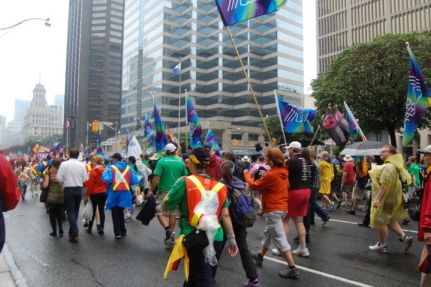
True, there had been some worrying signs after the masses assembled in Queen's Park and peacefully marched down University Avenue. We had seen a young man with his hand over an eye, blood running down his face, as his comrades ushered him through the crowd and cried out for a medic. Maybe he got in a cop's face, we thought. Eventually the protesters found themselves blocked off by a line of police at Queen Street East. The 5-0, decked out from head to toe in their latest quasi-fascist militarized police togs, shields raised and batons ready, may have been an intimidating presence, were it not for a crowd that refused to let itself be intimidated. A drum circle directly in front of the line provided a defiant flow of tribal beats; animal rights activists defended the sanctity of all life on this planet while I got my picture taken with a girl dressed up as a giant gray seal (a moment recorded for a TV update on Global News). When the cops took a menacing step forward, a girl cried out, "Sit down! They can't move us back if we're sitting down!" I grabbed my friend's megaphone and further spurred the crowd on to a sit-down protest - "the easiest form of protest", I declared - and the police were stopped in their tracks.

We experienced one unsettling moment when the police were ordered to don their gas masks. "Put on your bandanas!" yelled people in the crowd. As one officer perched high and aimed his riot gun menacingly at the protesters, we saw signs of tear gas in the air behind us. Yet for this afternoon, on this particular street, the crowd seemed safe for the time being. After a while, my friends and I decided to grab a bite at a Vietnamese restaurant and eventually found our way to Kensington Market, where we rented a room at a backpackers' hostel. Taking a breather, we switched on the TV for an update on how the Canadian media was reporting what we had just seen.
There was zero resemblance between the two narratives. What the CBC News Network, like the others, aired over and over was a single shot of a police car burning, sandwiched in-between footage of black-clad protesters smashing in the windows of banks and a Starbucks. There was no reporting whatsoever on what the protesters had actually been saying - i.e. what they were protesting against, or the myriad progressive solutions they put forth. Rather, there was a generic focus on "violent protesters", alarmism over the "anarchists" that had apparently swarmed the city, and an overall narrative that purported to offer all the necessary justification for Stephen Harper's $1.3 billion in security costs.

From this moment on, the dominant voices of the Canadian establishment completely submerged the voices of the protesters and drowned them in a sea of media-inspired agitation over the anarchist mob. I had seen members of the so-called Black Bloc as we filed out of Queen's Park: a wave of young people clad completely in black walking past me with bandanas covering their faces. It quickly became apparent that these people represented the outer boundaries of protest tactics - willing to go where the larger mass of people did not. The majority of the marchers I saw wielded a more subtly effective weapon: words. Chants of "peaceful protest" and "this is what democracy looks like" interspersed with "this is what a police state looks like" made clear the protesters' essentially Gandhian approach while maintaining a full-blooded stance of anger at the corporate elites who have plundered and poisoned our planet, destroyed the Canadian manufacturing base, pushed for bloody wars of imperial conquest all while relentlessly punishing the poor for the crimes of the wealthy bankers who crashed the world economy.

The most telling quote I heard the whole weekend came from an older gentleman beside me who faced down the line of police at University and Queen and asked a question as simple as it was profound: "What are you afraid of?" he demanded to know.
The answer, if you want it, is right here. But to summarize: the massive turnout of the police and tightening of the security apparatus was not simply about protecting the delicate ears of the G20 leaders. Rather, it was a dress rehearsal for the suppression of working class revolt by the Canadian capitalist elite, which fears the legitimate rage of a population facing long-term unemployment, endless war and looming ecological disaster. In this powder keg atmosphere, the corporate-financial elite is determined to hang on to its remaining privileges and power by any means necessary, including (as that formulation inevitably does) naked physical force.
You don't have to be a conspiracy theorist to find something very fishy in Black Bloc protesters managing to set multiple police cars on fire and break store windows in a city virtually under martial law, with over 5000 police officers patrolling downtown Toronto alone. I walked those city streets myself and you could not walk more than 25 metres without passing a cop. The idea that police would leave squad cars alone in this environment is difficult to believe, and leaves open the possibility that the Black Bloc was infiltrated by police provocateurs who incited and/or led the destruction of property in order to justify a brutal crackdown on the protesters. Such a suggestion is not fantasy; there is well-documented precedent for just such infiltration. After the images of the burning cars and broken windows were broadcast ad nauseum to a clueless Canadian TV audience, with newscasters squeezing the word "violence" as frequently as possible within allotted time frames, the picture of the protest as anarchist war zone was complete, and for the rest of the weekend police had a convenient excuse for any repressive measures they wished to enact.
My friends and I would learn that firsthand the next day.
We largely stayed out of the protest scene on Saturday night; with intermittent rain and a general cluelessness as to where the main action was, we caught the patron saint of independent media, Democracy Now! host Amy Goodman, at Trinity St. Paul's United Church. She was promoting her new book, Breaking The Sound Barrier, but also reporting on the G20 protests for the show. As a matter of fact, we passed her on University Avenue during the afternoon march; she seemed in a rush, but asked if we would attend her lecture that night. Full of wit and stories of her reporting adventures, Goodman eloquently put forward the case for a media that does not merely kowtow to the powerful, but performs the heavy investigative lifting that makes the Fourth Estate such a crucial pillar of democracy in popular lore.
On Sunday, after a brief lunch at vegan restaurant Urban Herbivore, we headed to Queen's Park in expectation of a protest similar in size to yesterday's. However, we found that the crowds had thinned out considerably. We first came across the anti-Zionist Jews fiercely denouncing the state of Israel; amusingly, other protesters soon set up a sign directly next to them admonishing passers-by to "support the state of Israel against Hamas".

But that was part of the protest's charm as we saw it; divergent groups (albeit with a broader progressive unity than apparent in this example) coming together to protest the corporatist policies of the G20 and the Canadian state. It seemed like democracy at its finest. While there were no large protests at Queen's Park this day, we did sit down with members of the Zeitgeist Movement sitting on the grass next to the Earthians. Like most of the protesters I talked to, they were well-read, passionate yet friendly and laidback individuals. I interviewed Lawrence, a member of the Zeitgeist Movement (far right in picture below).

The Zeitgeist Movement, he explained, is a non-political social movement advocating technological salvation for humanity by building on the foundational similarities between cultures to develop a more sustainable economic model. He held that the technology already exists to create a higher standard of living for all, but is held captive by our current monetary system which subordinates such visions to a more base pursuit of profit and raw materials.
We have the means to make sure that wars don’t happen. What are the barriers to that? A lot of it is because of resource scarcity. So you see wars happen over areas that are very resource-rich. What needs to happen is that all the resources of the planet need to be declared the common heritage of all the world’s people. The Zeitgeist Movement is the activist arm of something called the Venus Project, and the Venus Project is what’s putting forward these standards. It is the total redesign of the culture, talking about technologically unifying the globe. If we just update our thinking, and update the knowledge of the population as to the potential of our present-day technology to free us from boring and monotonous, socially offensive labour that you’re required to perform in order to feed and house yourself...we live in a society now where we’re wage slaves, essentially economic slaves. You know, a slave, you’re required to feed and house a slave. But an economic slave is required to feed and house themselves.
Impressed by his summary of the evils of capitalism, I told him that we had a lot in common and went into my usual argument about how socialism was the answer to humanity's problems. While he agreed with some of what I said, he intriguingly explained his opposition to my ideas by declaring that socialism didn't go far enough:
The one thing about socialism that is the same as capitalism, that’s the same as anything - free enterprise system, the same as fascism - is that they all operate within a monetary system [...] Money is really a root to a lot of large-scale problems. If you cannot get paid to do a job...I mean, 70% of non-violent crime is either drug-related or monetary-related, or related to money in some way.
We’re looking at unifying everyone. The problem with socialism is that it’s not radical enough. It’s radical, but it’s not radical enough. And when I say radical enough, I mean, when we’re talking about means of production or workers’ government, there doesn’t need to be that. The technology exists today to free everyone from food production, to free everyone from fabrication of homes and things like that. The technology today is incredible, and we’re able to do this.
So I understand where a socialist is coming from, where they’re like, “we want the people in power, we want a government of the people.” People not profits, that’s totally admirable. But is that possible in a monetary system? Greed and corruption are inherent in any sort of...when money is involved, when money is the reason for acquisition, incentive and exchange, especially incentive, especially incentive, when your incentive is to make money, then that comes first before [the] common good of [the] people.
After our chat with these interesting folks, my friends and I decided to head on down to where the action was. I made the decision to turn left onto a crosswalk, and didn't really perceive the danger of the cops on the traffic island until they said, "we're searching your bags." Note that was not a request. Anxious to avoid any legal trouble since I started a new job that requires a security clearance, I submitted to the search along with my two friends, one of whom had walked right into the lion's den. When the cops searched his bag, they found Ziploc bags filled with flour and paint that he had intended to pass out to protesters (telling them to add water) as a non-violent means of countering repressive crowd control by splashing the cops and making them look silly - in his words, "street theatre".

Barely seconds after the cops opened his bag, my friend was under arrest, in handcuffs and soon led into the back of a police van. The entire story of his imprisonment at "Torontanamo" is viewable here, but the gist is that his experience was rife with subtle forms of psychological torture. Those arrested were kept cuffed even when they were locked in a cage; they were denied food and water for long periods of time; forced to sleep on a cold concrete floor; he told of a couple 17/18-year-old girls who had been in lock-up for thirty hours without being allowed to call for legal aid. He was eventually processed, and the end charges were unbelievable. While the arresting officers had talked of a mischief charge, my friend is now accused of carrying dangerous weapons and looking at a six-month jail sentence. In a blatant violation of his Charter rights, he is banned from attending any future protests due to the bail conditions he agreed to in order to get released. No matter what you think of my friend's plan (and even he seems to think it was pretty stupid now), the threatened punishment in this case is grossly disproportional to the alleged crime. Although job considerations prevented me from acting in solidarity at his moment of arrest - although the only likely scenario would be my getting arrested too - I am fully supportive of him as he prepares to battle these outrageous charges.
Understandably, he describes his weekend as "cataclysmic", and it's hard to argue with that assessment. The weekend was full of innocent (and not-so-innocent) bystanders being arrested, harassed, or beaten by cops. The McGuinty government's cynical use of the 1939 Public Works Protection Act to radically expand police powers, which they attempted to slip past the media before it turned up on the e-laws website, is a useful gauge of this government's contempt for the people it claims to represent, as well as the intent of the police to go as far as they cared to go in harassing people. Although the law claimed people could be searched or arrested for not having ID within 5 metres of the perimeter fences, my experience on Sunday confirmed that in fact the police were exercising this power indiscriminately throughout the entire city. Following my friend's arrest, my remaining companion and I were searched on at least three more occasions that afternoon. On the initial search, police confiscated our ear plugs and bandanas - i.e., the only things we had to protect ourselves against crowd control devices like the LRAD sonic weapons and tear gas. No self-defense against the Canadian police state could be countenanced, it seemed.

Despite all the police violence and harassment, there remains one word I use to describe my experience of the G20: inspiring. Being stuck in small-town Kingston, it's hard to get across my excitement upon seeing thousands and thousands of committed activists all around me, whether labour groups like the PSAC, environmentalists such as Greenpeace ("There is no planet B" being one of my favourite signs), peaceniks, communists - in essence, all the groups that the media and mainstream discourse works hard to erase from the picture. They were all there in full force, daring to face down the militarized might of the capitalist state in order to reclaim democracy for the people (a sadly relevant distinction). I was inspired by the heartfelt dedication of the masses. Although I happened to see, believe it or not, a couple of Tea Party activists with an American flag - not to mention an old lady carrying a sign "Ayn Rand, Atlas Shrugged" - this was not that twisted parody of a popular uprising. Rather, it was from people smart enough to know who there real enemies were, and that higher level of awareness brought hope to me when I was beginning to drown in hopelessness for the future of humanity.
Along with the representatives of labour, environmentalists and youth - including the Ontario Federation of Labour, the Canadian Labour Congress and Greenpeace - I was stunned by the level of class consciousness and organized socialist resistance. Red banners and pictures of Karl Marx abounded, along with signs that said "Down with capitalism - long live socialism!" I marched with the Marxists, the Trotskyists, the Maoists and sampled party literature that was handed out to me on the street. For me, the novelty of seeing committed Marxists around me was enough, as I had grown used to the near-solitude of spreading that secular gospel in a small town like Kingston.

At one point early on, I talked to Adil Ahmed, representative of the Worker-Communist Party of Iraq in Canada. He discussed the work of Iranian communist Mansoor Hekmat, and his reasons for being in Toronto reflected the heart of the anti-capitalist movement. "We came here to protest this summit, of course," he said, "this summit for the capitalist system. They came here to save the capitalist system, of course. And we are here to protect the people, that is, the worker class. This summit is against workers and poor people around the world, and we came here to say no to your policy, no to your system [...] Socialism is the only solution for humanity."

As I heard the union groups around me singing "Solidarity Forever", I drank in the populism. Adil came from an older tradition than I, but his doctrine of socialist internationalism was precisely my ideological cup of tea. Where before I had despaired of the future for organized political action by the working class in Canada, now I knew there were millions of people out there willing to fight for justice in the face of corporate enslavement. The overwhelming task that now faces us is the unity of the working class as it enters this new era of unadulterated class struggle. With his description of the solidarity of workers across national borders, Adil brought out my inner optimist.
We are here. It doesn't matter what kind of peoples, what languages they speak. We're all together here to say no to capitalism. We are stronger [than the elites], of course. We are 90% of the people, they are 5% of the people of the world. If we unite, we can do everything we want - if we do. If we unite, we can do anything. That's why we are here.

All photos by Andréa Prins.
Monday, September 7, 2009
Health Care, American Racism and the Manchurian Candidate
And now, for a long overdue post. I've neglected this blog somewhat since I got a data management job in June working for the Ontario provincial government. It was a great seven weeks, and only reinforced my respect for the public sector. But don't think for a moment that I was so busy with that job that I neglected to follow the news. On the contrary, if anything, the fact that I was following the news so closely contributed to the absence of a new post for a couple of months.
Specifically, I'm speaking about the Obama administration's purported efforts to reform American health care. This is one of those subjects that, as a Canadian basking in the warm glow of a single-payer system, probably shouldn't concern me. But given the subject's dominance of the cable news cycle and the blogosphere, it's been impossible to avoid. And if I'm interested in American politics partially because it's so much more out there than Canadian politics, then this summer has been a stark lesson in both the ironclad grip of corporate lobbyists over the political process south of the border, and the maddening gullibility and stupidity of a large portion of that country's white working class.
Although I wasn't alive in 1967 to experience the Summer of Love, I've now had the misfortune to bear witness to 2009 devolving into the Summer of Hate. When the teabaggers and right-wing extremists first burst onto the national consciousness at the town hall debates, the sheer madness and idiocy of what they were saying stunned me into silence. Never before in my life had I seen so much misdirected anger as when these sad rubes let loose their redfaced rage at the prospect of receiving HEALTH CARE. Bush's wars of aggression, shredding of the Constitution and civil liberties, disregard for looming ecological catastrophe and undeclared class war against poor and working-class Americans all passed them by, but Fox News and hate radio have given them their marching orders: all the accumulated disasters facing the country as a result of eight years of Republican mismanagement (and, more to the point, 30 years of neoliberal economic dogma) have now been placed solely at the feet of one Barack Hussein Obama. Sadly, the town hall rubes are more than racist enough to fully embrace this logic.
Let's not kid ourselves: a good deal of the fears generated among misinformed white working class Americans by the right wing noise machine are based primarily on race. Tim Wise summed up best the reasons for their ludicrous belief that Obama, as total a Wall Street whore as has ever occupied the Oval Office, whose entire health care "plan" is based around salvaging the existing private insurance system, is secretly attempting to impose communism on America:
Nevertheless, the sheer level of venom directed at him by the extreme right is profoundly depressing because it fails to address any substantial, real problems with the bill. Rather, the lies, distortions and exaggerations peddled nonstop by Republican politicians and the right wing hate machine have raised ridiculous fears of "death panels" and pulling the plug on grandma. It's just really, really sad to see people again loudly protesting against their own best interests, because if they should be protesting anything, it's that the Obama plans don't go nearly far enough towards universal health care. But that would require a knowledgable, informed citizenry - impossible in the modern United States given the predominance of corporate disinformation campaigns that pass as "news".
I want to end this somewhat disjointed post by referring to two vastly different books I recently read as part of my ongoing attempt to understand conservative redneck culture, to figure out once and for all why these people consistently vote against their own best interests. The first book is a truly worthwhile read by Winchester, Virginia native Joe Bageant called Deer Hunting With Jesus: Dispatches from America's Class War. Bageant is a product of a culture saturated with God and guns, yet through education and 60s-era hippie liberalism managed to emerge a self-proclaimed "godless socialist", earning him mad props from yours truly. His book is a sad indictment of the South in which a toxic combination of religiosity, poor education and an otherwise commendable commitment to "self-reliance" has resulted in a population snugly in the hands of an ingenious Republican public relations machine. Conservatives' success in framing national issues through Southern cultural tropes is truly impressive in its diabolical success, and the only hope for liberals and progressives is to grab the bull by the horns and create new frames by which progressive policies can find a hold in these reactionary strongholds. This will be extraordinarily difficult given the utter corruption (via corporate campaign contributions) of the current Democratic Party.
The second book has value only in that its pages can be burned as a fuel source if necessary. Michael Savage is perhaps the most repugnant talk radio host in America, no easy feat in a field dominated by the likes of Rush Limbaugh and Sean Hannity. I recently perused his book The Savage Nation, and was predictably mortified by its scathing hatred towards Savage's imagined shadowy force of secular, gay-loving, America-hating liberal "Commu-Nazis". Reading this latest version, published in 2002, it was clear that the equation of Obama to Hitler by conservatives is by no means a recent phenomenon. But I gained some insight into the uniquely twisted reasoning of deluded white conservatives towards Obama and his apparently sinister aims. It goes something like this:
Throughout his book, Savage, like many conservative commentators, explicitly equates liberals with socialists, communists, Nazis and terrorists. Despite Obama's excruciatingly middle-of-the-road, mealy-mouthed centrism and fellating of Wall Street and the Washington establishment, right-wing media has successfully mined his record for anything that could conceivably be used to fit him into a convenient "angry black man" stereotype. The widespread coverage of Jeremiah Wright, magnification of Obama's relationship to William Ayers, and subsequent demonizing of Van Jones as a radical communist revolutionary all combined to create a Bizarro world version of Obama specifically designed to stoke fear among backwards conservative voters - a dichotomy best captured in this article by The Onion.
So the longstanding conservative equation of liberals with terrorists, combined with the exotic "otherness" of Obama's personal background (white mother, black Kenyan father) and his suspiciously Muslim-sounding middle name, Hussein, all conspire to create a version of Obama onto which any manner of conservative fears can be projected - socialism, wealth redistribution, affirmative action, you name it. The teabaggers, birthers and deathers all seem to truly believe Obama is some Manchurian candidate who will soon reveal his true nature as a communist/socialist/fascist/Muslim racist. That these ideas often contradict each other is no problem for far-right propagandists and true believers.
The fact that conservatives will demonize Obama no matter what he does makes his willingness to reach out to Republican politicians in a futile effort at "bipartisanship" that much more frustrating. In fact, the Democrats' approach to health care has been so undeniably weak that it's fair game to assume that that was their plan from the beginning. The always-excellent David Michael Green said as much in today's must-read column:
Specifically, I'm speaking about the Obama administration's purported efforts to reform American health care. This is one of those subjects that, as a Canadian basking in the warm glow of a single-payer system, probably shouldn't concern me. But given the subject's dominance of the cable news cycle and the blogosphere, it's been impossible to avoid. And if I'm interested in American politics partially because it's so much more out there than Canadian politics, then this summer has been a stark lesson in both the ironclad grip of corporate lobbyists over the political process south of the border, and the maddening gullibility and stupidity of a large portion of that country's white working class.
Although I wasn't alive in 1967 to experience the Summer of Love, I've now had the misfortune to bear witness to 2009 devolving into the Summer of Hate. When the teabaggers and right-wing extremists first burst onto the national consciousness at the town hall debates, the sheer madness and idiocy of what they were saying stunned me into silence. Never before in my life had I seen so much misdirected anger as when these sad rubes let loose their redfaced rage at the prospect of receiving HEALTH CARE. Bush's wars of aggression, shredding of the Constitution and civil liberties, disregard for looming ecological catastrophe and undeclared class war against poor and working-class Americans all passed them by, but Fox News and hate radio have given them their marching orders: all the accumulated disasters facing the country as a result of eight years of Republican mismanagement (and, more to the point, 30 years of neoliberal economic dogma) have now been placed solely at the feet of one Barack Hussein Obama. Sadly, the town hall rubes are more than racist enough to fully embrace this logic.
Let's not kid ourselves: a good deal of the fears generated among misinformed white working class Americans by the right wing noise machine are based primarily on race. Tim Wise summed up best the reasons for their ludicrous belief that Obama, as total a Wall Street whore as has ever occupied the Oval Office, whose entire health care "plan" is based around salvaging the existing private insurance system, is secretly attempting to impose communism on America:
It is not, in other words, a simple belief in smaller government or lower taxes that animates the near-hysterical cries from the right about wanting "their country back," from those who have presumably hijacked it: you know, those known lefties like Tim Geithner and Rahm Emanuel. No, what differentiates Obama from any of the other big spenders who have previously occupied the White House is principally one thing--his color. And it is his color that makes the bandying about of the "socialist" label especially effective and dangerous as a linguistic trope. Indeed, I would suggest that at the present moment, socialism is little more than racist code for the longstanding white fear that black folks will steal from them, and covet everything they have. The fact that the fear may now be of a black president, and not just some random black burglar hardly changes the fact that it is fear nonetheless: a deep, abiding suspicion that African American folk can't wait to take whitey's stuff, as payback, as reparations, as a way to balance the historic scales of injustice that have so long tilted in our favor. In short, the current round of red-baiting is based on implicit (and perhaps even explicit) appeals to white racial resentment. It is Mau-Mauing in the truest sense of the term, and especially since Obama's father was from the former colonial Kenya! Unless this is understood, left-progressive responses to the tactic will likely fall flat. After all, pointing out the absurdity of calling Obama a socialist, given his real policy agenda, will mean little if the people issuing the charge were never using the term in the literal sense, but rather, as a symbol for something else entirely.Of course, Obama has made it much harder for progressives to defend him, given his propensity for spitting in the face of his most loyal supporters. His health care bill is to the health insurance industry what TARP was to Wall Street - a government bailout in which taxpayers subsidize private industry. The great Matt Taibbi explained in his recent Rolling Stone article on health care why the bill that ultimately emerges may actually be worse than no bill at all, since it essentially forces the population to buy a defective product. This is classic Obama - he has always offered pretty words while his actual policies have constituted the grossest kind of corporate welfare.
To begin with, and this is something often under-appreciated by the white left, to the right and its leadership (if not necessarily its foot-soldiers), the battle between capitalism and communism/socialism has long been seen as a racialized conflict. First, of course, is the generally non-white hue of those who have raised the socialist or communist banner from a position of national leadership. Most such places and persons have been of color: China, Vietnam, North Korea, Cuba, assorted places in Latin America from time to time, or the Caribbean, or in Africa. With the exception of the former Soviet Union and its immediate Eastern European satellites--which are understood as having had state socialism foisted upon them, rather than having it freely chosen through their own revolutions from below--Marxism in practice has been a pretty much exclusively non-white venture.
And even the Russians were seen through racialized lenses by some of America's most vociferous cold warriors. To wit, consider what General Edward Rowney, who would become President Reagan's chief arms negotiator with the Soviets, told Manning Marable in the late 1970s, and which Marable then recounted in his book, The Great Wells of Democracy:
"One day I asked Rowney about the prospects for peace, and he replied that meaningful negotiations with the Russian Communists were impossible. 'The Russians,' Rowney explained, never experienced the Renaissance, or took part in Western civilization or culture. I pressed the point, asking whether his real problem with Russia was its adherence to communism. Rowney snapped, 'Communism has nothing to do with it!' He looked thoughtful for a moment and then said simply, 'The real problem with Russians is that they are Asiatics'."
In the present day, the only remaining socialists in governance on the planet are of color: in places like Cuba or Venezuela, perhaps China (though to a more truncated extent, given their embrace of the market in recent decades) and, on the lunatic Stalinist fringe, North Korea. These are the last remaining standard-bearers, in leadership positions, who would actually use the term socialist to describe themselves. Given the color-coding of socialism in the 21st century, at the level of governance, to use the label to describe President Obama and his administration, has the effect of tying him to these "other" socialists in power. Although he has nearly nothing in common with them politically or in terms of his policy prescriptions, he is a man of color, so the connection is made, mentally, even if it carries no intellectual or factual truth.
Nevertheless, the sheer level of venom directed at him by the extreme right is profoundly depressing because it fails to address any substantial, real problems with the bill. Rather, the lies, distortions and exaggerations peddled nonstop by Republican politicians and the right wing hate machine have raised ridiculous fears of "death panels" and pulling the plug on grandma. It's just really, really sad to see people again loudly protesting against their own best interests, because if they should be protesting anything, it's that the Obama plans don't go nearly far enough towards universal health care. But that would require a knowledgable, informed citizenry - impossible in the modern United States given the predominance of corporate disinformation campaigns that pass as "news".
I want to end this somewhat disjointed post by referring to two vastly different books I recently read as part of my ongoing attempt to understand conservative redneck culture, to figure out once and for all why these people consistently vote against their own best interests. The first book is a truly worthwhile read by Winchester, Virginia native Joe Bageant called Deer Hunting With Jesus: Dispatches from America's Class War. Bageant is a product of a culture saturated with God and guns, yet through education and 60s-era hippie liberalism managed to emerge a self-proclaimed "godless socialist", earning him mad props from yours truly. His book is a sad indictment of the South in which a toxic combination of religiosity, poor education and an otherwise commendable commitment to "self-reliance" has resulted in a population snugly in the hands of an ingenious Republican public relations machine. Conservatives' success in framing national issues through Southern cultural tropes is truly impressive in its diabolical success, and the only hope for liberals and progressives is to grab the bull by the horns and create new frames by which progressive policies can find a hold in these reactionary strongholds. This will be extraordinarily difficult given the utter corruption (via corporate campaign contributions) of the current Democratic Party.
The second book has value only in that its pages can be burned as a fuel source if necessary. Michael Savage is perhaps the most repugnant talk radio host in America, no easy feat in a field dominated by the likes of Rush Limbaugh and Sean Hannity. I recently perused his book The Savage Nation, and was predictably mortified by its scathing hatred towards Savage's imagined shadowy force of secular, gay-loving, America-hating liberal "Commu-Nazis". Reading this latest version, published in 2002, it was clear that the equation of Obama to Hitler by conservatives is by no means a recent phenomenon. But I gained some insight into the uniquely twisted reasoning of deluded white conservatives towards Obama and his apparently sinister aims. It goes something like this:
Throughout his book, Savage, like many conservative commentators, explicitly equates liberals with socialists, communists, Nazis and terrorists. Despite Obama's excruciatingly middle-of-the-road, mealy-mouthed centrism and fellating of Wall Street and the Washington establishment, right-wing media has successfully mined his record for anything that could conceivably be used to fit him into a convenient "angry black man" stereotype. The widespread coverage of Jeremiah Wright, magnification of Obama's relationship to William Ayers, and subsequent demonizing of Van Jones as a radical communist revolutionary all combined to create a Bizarro world version of Obama specifically designed to stoke fear among backwards conservative voters - a dichotomy best captured in this article by The Onion.
So the longstanding conservative equation of liberals with terrorists, combined with the exotic "otherness" of Obama's personal background (white mother, black Kenyan father) and his suspiciously Muslim-sounding middle name, Hussein, all conspire to create a version of Obama onto which any manner of conservative fears can be projected - socialism, wealth redistribution, affirmative action, you name it. The teabaggers, birthers and deathers all seem to truly believe Obama is some Manchurian candidate who will soon reveal his true nature as a communist/socialist/fascist/Muslim racist. That these ideas often contradict each other is no problem for far-right propagandists and true believers.
The fact that conservatives will demonize Obama no matter what he does makes his willingness to reach out to Republican politicians in a futile effort at "bipartisanship" that much more frustrating. In fact, the Democrats' approach to health care has been so undeniably weak that it's fair game to assume that that was their plan from the beginning. The always-excellent David Michael Green said as much in today's must-read column:
Of course, he's also chosen to put healthcare reform on the table as the signature legislative initiative probably of his entire presidency. That's fine, but watching him in action I sometimes wonder if this clown really and actually wants a second term. I mean, if you had asked me in January, "How could Obama bungle this program most thoroughly?", I would have written a prescription that varies little from what we've observed over the last eight months: Don't frame the issue, but instead let the radical right backed by greedy industry monsters do it, on the worst possible terms for you. And to you. Don't fight back when they say the most outrageous things about your plan. In fact, don't even have a plan. Let Congress do it. Better yet, let the by-far-and-away-minority party have an equal voice in the proceedings, even if they ultimately won't vote for the bill under any circumstances, and even while they're running around trashing it and you in the most egregious terms. Have these savages negotiate with a small group of right-wing Democrats, all of them major recipients of industry campaign donations. Blow off your base completely. Cut secret sweetheart deals with the Big Pharma and Big Insurance corporate vampires. Build a communications strategy around a series of hapless press conferences and town hall meetings, waiting until it's too late to give a major speech on the issue. Set a timetable for action and then let it slip. Indicate what you want in the bill but then be completely unclear about whether you necessarily require those things. Travel all over the world doing foreign policy meet-and-greets. Go on vacation in the heat of the battle. Rinse and repeat.Trust me, if Obama was actually the Islamic Marxist revolutionary racist of Glenn Beck's psychotic delusions, he'd be a lot more effective at actually getting things done.Altogether, it's an astonishingly perfect recipe for getting rolled, so much so that I'm not the first person to have wondered out loud if that was actually the president's intention all along. Look at this freaking fool. Now look at the guy who ran a letter-perfect, disciplined, textbook, insurgent, victorious campaign for the White House. Can they possibly be the same person? And, since they obviously are, is there possibly another explanation for this disaster besides an intentional boot? I dunno. But what I do know is this. Obama's very best-case scenario for healthcare legislation right now represents a ton of lost votes in 2010 and 2012. And the worse that scenario gets, the worse he and his party do. But even a 'success' in the months ahead will produce a tepid bill, a mistrustful public, an inflamed and unanswered radical right, and a mealy-mouthed new government program that doesn't even begin to go online until 2013. A real vote-getter that, eh?
Subscribe to:
Comments (Atom)