Showing posts with label G20. Show all posts

Sunday, July 4, 2010

In The Belly of the Beast: My G20 Experience

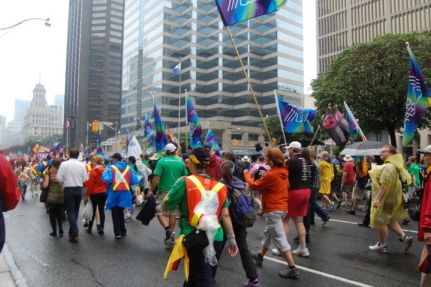
It had been, I felt, a productive day of protest. Thousands of people had defied the rain on this gray Saturday, June 26, 2010 to vent their rage against the global corporate elite as its leading representatives met in Toronto for the G20 summit. My friends and I took advantage of a free bus ride offered in Kingston by the Public Service Alliance of Canada (PSAC) to make our way to the T-dot that weekend, and what I had seen so far had left me deeply moved. The sheer size of the turnout was impressive, especially given the poor weather, and seeing so many passionate activists engaged in that most basic and essential of democratic activities - grassroots protest - was a powerful rebuttal to any suspicions I might have had that the Canadian public was too lethargic to get out in the streets and make its voice heard.


True, there had been some worrying signs after the masses assembled in Queen's Park and peacefully marched down University Avenue. We had seen a young man with his hand over an eye, blood running down his face, as his comrades ushered him through the crowd and cried out for a medic. Maybe he got in a cop's face, we thought. Eventually the protesters found themselves blocked off by a line of police at Queen Street East. The 5-0, decked out from head to toe in their latest quasi-fascist militarized police togs, shields raised and batons ready, may have been an intimidating presence, were it not for a crowd that refused to let itself be intimidated. A drum circle directly in front of the line provided a defiant flow of tribal beats; animal rights activists defended the sanctity of all life on this planet while I got my picture taken with a girl dressed up as a giant gray seal (a moment recorded for a TV update on Global News). When the cops took a menacing step forward, a girl cried out, "Sit down! They can't move us back if we're sitting down!" I grabbed my friend's megaphone and further spurred the crowd on to a sit-down protest - "the easiest form of protest", I declared - and the police were stopped in their tracks.


We experienced one unsettling moment when the police were ordered to don their gas masks. "Put on your bandanas!" yelled people in the crowd. As one officer perched high and aimed his riot gun menacingly at the protesters, we saw signs of tear gas in the air behind us. Yet for this afternoon, on this particular street, the crowd seemed safe for the time being. After a while, my friends and I decided to grab a bite at a Vietnamese restaurant and eventually found our way to Kensington Market, where we rented a room at a backpackers' hostel. Taking a breather, we switched on the TV for an update on how the Canadian media was reporting what we had just seen.

There was zero resemblance between the two narratives. What the CBC News Network, like the others, aired over and over was a single shot of a police car burning, sandwiched in-between footage of black-clad protesters smashing in the windows of banks and a Starbucks. There was no reporting whatsoever on what the protesters had actually been saying - i.e. what they were protesting against, or the myriad progressive solutions they put forth. Rather, there was a generic focus on "violent protesters", alarmism over the "anarchists" that had apparently swarmed the city, and an overall narrative that purported to offer all the necessary justification for Stephen Harper's $1.3 billion in security costs.


From this moment on, the dominant voices of the Canadian establishment completely submerged the voices of the protesters and drowned them in a sea of media-inspired agitation over the anarchist mob. I had seen members of the so-called Black Bloc as we filed out of Queen's Park: a wave of young people clad completely in black walking past me with bandanas covering their faces. It quickly became apparent that these people represented the outer boundaries of protest tactics - willing to go where the larger mass of people did not. The majority of the marchers I saw wielded a more subtly effective weapon: words. Chants of "peaceful protest" and "this is what democracy looks like" interspersed with "this is what a police state looks like" made clear the protesters' essentially Gandhian approach while maintaining a full-blooded stance of anger at the corporate elites who have plundered and poisoned our planet, destroyed the Canadian manufacturing base, pushed for bloody wars of imperial conquest all while relentlessly punishing the poor for the crimes of the wealthy bankers who crashed the world economy.


The most telling quote I heard the whole weekend came from an older gentleman beside me who faced down the line of police at University and Queen and asked a question as simple as it was profound: "What are you afraid of?" he demanded to know.

The answer, if you want it, is right here. But to summarize: the massive turnout of the police and tightening of the security apparatus was not simply about protecting the delicate ears of the G20 leaders. Rather, it was a dress rehearsal for the suppression of working class revolt by the Canadian capitalist elite, which fears the legitimate rage of a population facing long-term unemployment, endless war and looming ecological disaster. In this powder keg atmosphere, the corporate-financial elite is determined to hang on to its remaining privileges and power by any means necessary, including (as that formulation inevitably does) naked physical force.

You don't have to be a conspiracy theorist to find something very fishy in Black Bloc protesters managing to set multiple police cars on fire and break store windows in a city virtually under martial law, with over 5000 police officers patrolling downtown Toronto alone. I walked those city streets myself and you could not walk more than 25 metres without passing a cop. The idea that police would leave squad cars alone in this environment is difficult to believe, and leaves open the possibility that the Black Bloc was infiltrated by police provocateurs who incited and/or led the destruction of property in order to justify a brutal crackdown on the protesters. Such a suggestion is not fantasy; there is well-documented precedent for just such infiltration. After the images of the burning cars and broken windows were broadcast ad nauseum to a clueless Canadian TV audience, with newscasters squeezing the word "violence" as frequently as possible within allotted time frames, the picture of the protest as anarchist war zone was complete, and for the rest of the weekend police had a convenient excuse for any repressive measures they wished to enact.

My friends and I would learn that firsthand the next day.

We largely stayed out of the protest scene on Saturday night; with intermittent rain and a general cluelessness as to where the main action was, we caught the patron saint of independent media, Democracy Now! host Amy Goodman, at Trinity St. Paul's United Church. She was promoting her new book, Breaking The Sound Barrier, but also reporting on the G20 protests for the show. As a matter of fact, we passed her on University Avenue during the afternoon march; she seemed in a rush, but asked if we would attend her lecture that night. Full of wit and stories of her reporting adventures, Goodman eloquently put forward the case for a media that does not merely kowtow to the powerful, but performs the heavy investigative lifting that makes the Fourth Estate such a crucial pillar of democracy in popular lore.

On Sunday, after a brief lunch at vegan restaurant Urban Herbivore, we headed to Queen's Park in expectation of a protest similar in size to yesterday's. However, we found that the crowds had thinned out considerably. We first came across the anti-Zionist Jews fiercely denouncing the state of Israel; amusingly, other protesters soon set up a sign directly next to them admonishing passers-by to "support the state of Israel against Hamas".


But that was part of the protest's charm as we saw it; divergent groups (albeit with a broader progressive unity than apparent in this example) coming together to protest the corporatist policies of the G20 and the Canadian state. It seemed like democracy at its finest. While there were no large protests at Queen's Park this day, we did sit down with members of the Zeitgeist Movement sitting on the grass next to the Earthians. Like most of the protesters I talked to, they were well-read, passionate yet friendly and laidback individuals. I interviewed Lawrence, a member of the Zeitgeist Movement (far right in picture below).


The Zeitgeist Movement, he explained, is a non-political social movement advocating technological salvation for humanity by building on the foundational similarities between cultures to develop a more sustainable economic model. He held that the technology already exists to create a higher standard of living for all, but is held captive by our current monetary system which subordinates such visions to a more base pursuit of profit and raw materials.

We have the means to make sure that wars don’t happen. What are the barriers to that? A lot of it is because of resource scarcity. So you see wars happen over areas that are very resource-rich. What needs to happen is that all the resources of the planet need to be declared the common heritage of all the world’s people. The Zeitgeist Movement is the activist arm of something called the Venus Project, and the Venus Project is what’s putting forward these standards. It is the total redesign of the culture, talking about technologically unifying the globe. If we just update our thinking, and update the knowledge of the population as to the potential of our present-day technology to free us from boring and monotonous, socially offensive labour that you’re required to perform in order to feed and house yourself...we live in a society now where we’re wage slaves, essentially economic slaves. You know, a slave, you’re required to feed and house a slave. But an economic slave is required to feed and house themselves.


Impressed by his summary of the evils of capitalism, I told him that we had a lot in common and went into my usual argument about how socialism was the answer to humanity's problems. While he agreed with some of what I said, he intriguingly explained his opposition to my ideas by declaring that socialism didn't go far enough:

The one thing about socialism that is the same as capitalism, that’s the same as anything - free enterprise system, the same as fascism - is that they all operate within a monetary system [...] Money is really a root to a lot of large-scale problems. If you cannot get paid to do a job...I mean, 70% of non-violent crime is either drug-related or monetary-related, or related to money in some way.

We’re looking at unifying everyone. The problem with socialism is that it’s not radical enough. It’s radical, but it’s not radical enough. And when I say radical enough, I mean, when we’re talking about means of production or workers’ government, there doesn’t need to be that. The technology exists today to free everyone from food production, to free everyone from fabrication of homes and things like that. The technology today is incredible, and we’re able to do this.

So I understand where a socialist is coming from, where they’re like, “we want the people in power, we want a government of the people.” People not profits, that’s totally admirable. But is that possible in a monetary system? Greed and corruption are inherent in any sort of...when money is involved, when money is the reason for acquisition, incentive and exchange, especially incentive, especially incentive, when your incentive is to make money, then that comes first before [the] common good of [the] people.


After our chat with these interesting folks, my friends and I decided to head on down to where the action was. I made the decision to turn left onto a crosswalk, and didn't really perceive the danger of the cops on the traffic island until they said, "we're searching your bags." Note that was not a request. Anxious to avoid any legal trouble since I started a new job that requires a security clearance, I submitted to the search along with my two friends, one of whom had walked right into the lion's den. When the cops searched his bag, they found Ziploc bags filled with flour and paint that he had intended to pass out to protesters (telling them to add water) as a non-violent means of countering repressive crowd control by splashing the cops and making them look silly - in his words, "street theatre".


Barely seconds after the cops opened his bag, my friend was under arrest, in handcuffs and soon led into the back of a police van. The entire story of his imprisonment at "Torontanamo" is viewable here, but the gist is that his experience was rife with subtle forms of psychological torture. Those arrested were kept cuffed even when they were locked in a cage; they were denied food and water for long periods of time; forced to sleep on a cold concrete floor; he told of a couple 17/18-year-old girls who had been in lock-up for thirty hours without being allowed to call for legal aid. He was eventually processed, and the end charges were unbelievable. While the arresting officers had talked of a mischief charge, my friend is now accused of carrying dangerous weapons and looking at a six-month jail sentence. In a blatant violation of his Charter rights, he is banned from attending any future protests due to the bail conditions he agreed to in order to get released. No matter what you think of my friend's plan (and even he seems to think it was pretty stupid now), the threatened punishment in this case is grossly disproportional to the alleged crime. Although job considerations prevented me from acting in solidarity at his moment of arrest - although the only likely scenario would be my getting arrested too - I am fully supportive of him as he prepares to battle these outrageous charges.

Understandably, he describes his weekend as "cataclysmic", and it's hard to argue with that assessment. The weekend was full of innocent (and not-so-innocent) bystanders being arrested, harassed, or beaten by cops. The McGuinty government's cynical use of the 1939 Public Works Protection Act to radically expand police powers, which they attempted to slip past the media before it turned up on the e-laws website, is a useful gauge of this government's contempt for the people it claims to represent, as well as the intent of the police to go as far as they cared to go in harassing people. Although the law claimed people could be searched or arrested for not having ID within 5 metres of the perimeter fences, my experience on Sunday confirmed that in fact the police were exercising this power indiscriminately throughout the entire city. Following my friend's arrest, my remaining companion and I were searched on at least three more occasions that afternoon. On the initial search, police confiscated our ear plugs and bandanas - i.e., the only things we had to protect ourselves against crowd control devices like the LRAD sonic weapons and tear gas. No self-defense against the Canadian police state could be countenanced, it seemed.


Despite all the police violence and harassment, there remains one word I use to describe my experience of the G20: inspiring. Being stuck in small-town Kingston, it's hard to get across my excitement upon seeing thousands and thousands of committed activists all around me, whether labour groups like the PSAC, environmentalists such as Greenpeace ("There is no planet B" being one of my favourite signs), peaceniks, communists - in essence, all the groups that the media and mainstream discourse works hard to erase from the picture. They were all there in full force, daring to face down the militarized might of the capitalist state in order to reclaim democracy for the people (a sadly relevant distinction). I was inspired by the heartfelt dedication of the masses. Although I happened to see, believe it or not, a couple of Tea Party activists with an American flag - not to mention an old lady carrying a sign "Ayn Rand, Atlas Shrugged" - this was not that twisted parody of a popular uprising. Rather, it was from people smart enough to know who there real enemies were, and that higher level of awareness brought hope to me when I was beginning to drown in hopelessness for the future of humanity.

Along with the representatives of labour, environmentalists and youth - including the Ontario Federation of Labour, the Canadian Labour Congress and Greenpeace - I was stunned by the level of class consciousness and organized socialist resistance. Red banners and pictures of Karl Marx abounded, along with signs that said "Down with capitalism - long live socialism!" I marched with the Marxists, the Trotskyists, the Maoists and sampled party literature that was handed out to me on the street. For me, the novelty of seeing committed Marxists around me was enough, as I had grown used to the near-solitude of spreading that secular gospel in a small town like Kingston.


At one point early on, I talked to Adil Ahmed, representative of the Worker-Communist Party of Iraq in Canada. He discussed the work of Iranian communist Mansoor Hekmat, and his reasons for being in Toronto reflected the heart of the anti-capitalist movement. "We came here to protest this summit, of course," he said, "this summit for the capitalist system. They came here to save the capitalist system, of course. And we are here to protect the people, that is, the worker class. This summit is against workers and poor people around the world, and we came here to say no to your policy, no to your system [...] Socialism is the only solution for humanity."


As I heard the union groups around me singing "Solidarity Forever", I drank in the populism. Adil came from an older tradition than I, but his doctrine of socialist internationalism was precisely my ideological cup of tea. Where before I had despaired of the future for organized political action by the working class in Canada, now I knew there were millions of people out there willing to fight for justice in the face of corporate enslavement. The overwhelming task that now faces us is the unity of the working class as it enters this new era of unadulterated class struggle. With his description of the solidarity of workers across national borders, Adil brought out my inner optimist.

We are here. It doesn't matter what kind of peoples, what languages they speak. We're all together here to say no to capitalism. We are stronger [than the elites], of course. We are 90% of the people, they are 5% of the people of the world. If we unite, we can do everything we want - if we do. If we unite, we can do anything. That's why we are here.

All photos by Andréa Prins.

Tuesday, June 22, 2010

This World is Going to Hell...How to Stop It

That hoary old cliché, “the world is going to hell in a handbasket”, seems truer every day. Wake up this morning and you can read about the ongoing worst environmental disaster in human history, a gushing torrent of crude oil destroying not only one of the world’s most diverse wildlife preserves, but the economy and way of life for millions of Gulf state residents. You can read about Sergeant James Patrick Macneil, 28, the latest Canadian soldier to die in our pointless imperial war in Afghanistan. Closer to home, we see that the federal government is getting its money’s worth out of the $1 billion it squandered on security for the G20 summit in Toronto. Pepper spray, LRAD sonic weaponry, plastic bullets, and now, we get word that they will indeed be breaking out the water cannons. Yes, free speech is alive and well in the Great White North, as you can tell by the ominous police presence that surrounds any hint of spontaneity or protest. But it’s not just here that speaking out about injustice can get you tossed in a jail cell. The Supreme Court of the United States just voted 6-3 to severely restrict First Amendment rights by declaring that verbal support for non-violent, lawful activity is equivalent to giving material aid to terrorists. Jimmy Carter better be careful the next time he monitors elections in Lebanon. Finally, I just looked up at the TV to see that Canada has placed additional sanctions on Iran, the pariah state that absorbs all the collective wrath of the wealthiest nations on earth on behalf of oil companies and the military-industrial complex. I’ve said what I wanted to say about the ongoing propaganda campaign to depict this weak nation - which has fully complied with its obligations under the Non-Proliferation Treaty, unlike other countries which refused to even sign it - as some kind of sinister threat to world peace. Unfortunately, the Money Boyz control the flow of information and they are fixated on regime change in Iran. Which, of course, has nothing to do with oil.


It’s bad enough to read all this bad news. But what’s far, far worse is watching the media trot out, day after day, the same people who are responsible for these disasters and injustices, who profit from them, who keep them going, to defend the actions of the elite, block any positive changes, and shower blame on the victims of their criminal policies. Of course, it’s hard to beat the American media elite for sheer tone deafness. Jabba the Hutt lashed out at the poor again on his radio show the other day, literally ridiculing children who go hungry and depend on school lunches to obtain sufficient nutrients. Fat man Rush, who likely hasn’t seen his toes since his last Vietnam deferment, suggested they could just look in the fridge for ding-dongs, and if not, there's always the dumpster. There is literally no difference, save a couple centuries, between his despicable "advice" and Marie Antoninette suggesting that the solution for starving French peasants is to “let them eat cake.”

Then there is the ever-more extreme backwaters of the American far right, which gets nuttier by the day to the corporate media’s delight. Sharron Angle brought out an old Republican standby – denigrating the poor and unemployed as “deadbeats” determined to stay on welfare. The meme was echoed by Fox News talking heads, who rubbed salt in the wounds of the 1.2 million Americans whose unemployment benefits just ran out by declaring that they spend most of the money on junk food, beer, cable TV and comic books anyway. Also, Tea Party favourite Dr. Rand Paul insisted that the unemployed are just afraid to get their hands dirty and need to start doing lousy jobs, but that didn’t stop him from defending high pay for medical practitioners. Doctors, he declared, “deserve to earn a comfortable living.” As Digby declared, isn’t it funny how those advocating “tough love” austerity policies are never in danger of being affected either way?

I despair for humanity. The only real solution for the problems that plague the world today, from foreign wars to ecological disaster to extreme inequality, is socialism, the democratic control of society’s resources and the means of production on behalf of the working class. But such a proposal is unthinkable to the corporate overlords that control our society and the information that reaches the masses. They actively fight it through their politicians and their media, but there’s only so much they can do to control an enraged population faced with long-term unemployment and governments they correctly feel do not represent them. More dangerous is when they take that legitimate rage and deploy it against powerless targets like unions, the poor and minorities, through the help of bought-and-paid for demagogues like Glenn Beck or whoever his Canadian equivalent will be on the just-announced Sun TV News Channel. And the scariest part is that it seems to work.

No matter how bad things get, the broad masses appear equally unable to imagine alternatives to the status quo, despite their much-hyped exasperation with it. Elections across the world have repeatedly returned to power the same bourgeois political parties, all with the same deranged, nonsensical neo-Hooverist prescriptions for the global economy: austerity, cutting spending, and reining in the deficit, because what matters is continued profits for banks, not the devastation which prolonged unemployment continues to wreak on working people. And yet the people just keep voting them back in. Britain elects Conservative David Cameron. Germany throws in its lot with Angela Merkel and the free market-worshipping Free Democratic Party. No matter how much bad press Stephen Harper gets, Canadians remain enslaved to the Conservative-Liberal big business duopoly while the NDP runs from any thoughts of socialism. American primary voters backed corporate whores like Blue Dog “Democrat” Blanche Lincoln (D-AK), the senator from Wal-Mart, simply because Obama endorsed her. They also rejected progressive voices like Marcy Winograd in California. It seems there’s only one direction for working-class politics in America to go – further and further right.

Part of the problem is that there is no strong, organized working class movement in any of these countries that can find representation in government. Traditional social-democratic parties are a joke, having been completely enslaved to neoliberal dogma years ago. All will embrace the austerity policies that make the working class pay for the banksters’ crimes (see: France’s Socialist Party, the British Labour Party). The decades-long demonization of Marxist ideas during the Cold War has ensured that the most powerful theoretical tool for understanding the current economic crisis goes ignored by the masses that would most benefit from that knowledge.


The Canadian citizen who wishes to take a Marxist approach to the political struggle has a range of choices, none of them all that appealing. The Communist Party of Canada is the second-oldest political party in the country after the Liberals, yet its historical associations with Stalinism have left it on the political fringe. The party membership has aged to the point where it cannot represent an active, youthful political movement. As good as the People’s Voice newspaper is, its writers retain a 1930s view of the working class and revel in archaic terminology. Whatever the party’s policies, its unwillingness to confront the legacy of Stalinism or adopt the internationalist approach of Leon Trotsky means it will remain glued to the Soviet past. To take a coldly realistic view of the situation, it is highly unlikely that any party with the word “Communist” in its name will be able to avoid the totalitarian connotations of historical Communist parties led by Stalin and Mao, with their gross crimes against humanity. That fact also condemns the Communist Party of Canada (Marxist-Leninist), which ran out of steam around the time it fixated on Albanian dictator Enver Hoxha as its anti-revisionist model.

The Socialist Equality Party (Canada), which I’ve written about before, seems to have by far the best platform of any leftist party. Its policies are Trotskyist in nature and internationalist in scope, which in my mind points the way forward for the proletariat: the unity of workers across borders against their exploiters in the parasitic corporate-financial class. Unfortunately, my early enthusiasm for the SEP has waned somewhat after discovering how little infrastructure the party has in Canada – in my experience, basically none. The SEP’s Canadian office does not even have a phone number or e-mail address, and there’s little realistic hope for a party with such a laughable lack of organization. Short of spreading the word through social media and registering the SEP as an official political party, it remains very much a movement in theory only.

That leaves the New Democratic Party. I was made aware via Facebook that there is in fact an NDP Socialist Caucus. I completely agree with the Caucus’ policies and their general direction, i.e. the only way the NDP can survive as a relevant party is by moving to the left. Canada already has a centre-left bourgeois party: the Liberals. The NDP need to reclaim the ideological high ground by drawing on their roots with Tommy Douglas and the Co-operative Commonwealth Federation, which declared its intention to work until capitalism was eradicated. While the NDP leadership is considerably to the right of its rank and file, its existence as a major political party with representatives in Parliament gives it a clout that no other Canadian party to the left of the Liberals can boast. For now, with the SEP little more than a publishing organization, there seems to be little alternative to pushing for the adoption of socialist principles within the NDP. Ontario party leader Andrea Horwath has indicated her openness to this approach, suggesting an NDP where members need not “check their socialism at the door.”

The political element is an important part of the class struggle, but any real progress is years away and will not affect the underlying dynamic of Canadian politics today, nor the subservience of our politicians to the interests of transnational capital. For the moment, the only course of action is mass organization, demonstrating on the streets in defiance of our government’s corporatist polices. I call for this tactic regularly, but too often it remains purely abstract and theoretical, with no real-world lynchpin.

Well, the opportunity arrives this weekend as the G20 congregates in Toronto. The Harper government’s monstrous waste of $1 billion for security, not to mention the overall tone of media reports promoting new weapons the police seem keen to use, indicate that the state is fully prepared to use violence as a means of crushing dissent. That fact in itself is not surprising, but the media’s approach suggests they will pin any blame on protesters. The use of police provocateurs to justify a crackdown is not out of the question. The decisive factor is, will the citizenry allow itself to be intimidated? Or will it make its presence and concerns known to a nationwide, nay, worldwide audience? Will it refuse to submit to the bludgeoning force of the modern police state?

I’ll be in Toronto this weekend to answer in the affirmative. So should you. Make your voice heard!

Saturday, September 26, 2009

The G20 Travesty

The recent economic summit of the G20 nations in Pittsburgh was everything I expected - that is, a glossy stage show in which the chief political representatives of world banking interests offered vague statements praising the so-called economic recovery (for the bankers, that is) while pressing forward on plans to make working people pay for the crimes of international finance, all while peaceful protesters outside faced now-routine police brutality bolstered by the most technologically-advanced methods of crowd dispersal/oppression. Tear gas, pepper spray, batons, rubber bullets and sonic cannons (also known as Long Range Acoustic Devices) were all deployed as the international elite attempted to neutralize any popular criticism of its reactionary policies.

According to the G20, economic recovery will require governments to reduce spending and squeeze workers by lowering their living standard, a solution which does not exactly square with their professed goals of creating jobs and reducing poverty. Perhaps the weakness of their actual economic plans was what prompted leaders of the Western nations to distract the media's attention by engaging in this heartwarming act of political theatre:

In what has all the hallmarks of an orchestrated political provocation, the United States, Britain and France, with the support of Germany, denounced a supposedly secret Iranian nuclear plant, threatened stepped-up economic sanctions and possible military action unless the facility was immediately open to inspection.

In a joint announcement Friday morning at the G20 summit in Pittsburgh, US President Barack Obama, British Prime Minister Gordon Brown and French President Nicolas Sarkozy appeared together before television cameras to issue the warning. Germany’s Chancellor Angela Merkel, who had left Pittsburgh to return home, issued her own statement of support for the threats against Iran.

Obama declared, “The Iranian government must now demonstrate through deeds its peaceful intentions or be held accountable to international standards and international law.” He gave Iranian President Mahmoud Ahmadinejad six days to respond—by the time of an October 1 meeting in Geneva. His approach echoed that of George W. Bush seven years ago in citing an alleged nuclear weapons program as the basis for going to war against Iraq.

Talk about déjà vu all over again. Is the memory of the public really so short that the buildup to war against Iraq in 2003 - supported by the same bogus claims about weapons of mass destruction and the same hypocritical lectures about international law from the world's most powerful rogue state - has already been forgotten as we see the exact same propaganda applied to Iran? That's a rhetorical question, of course; public opinion has almost always been irrelevant when it comes to U.S. foreign policy. But it is depressing to see the foreign policy elite do everything in its power to beat the drums of war, especially at a conference supposedly designed to address the economic crisis. Then again, we shouldn't be surprised; unscrupulous politicians have always used war as a distraction from and "solution" to economic problems.

Canadian Foreign Minister Lawrence Cannon characteristically followed the lead of the United States, condemning Iran for its "continued refusal" to listen to resolutions by the UN Security Council and the International Atomic Energy Agency. Unless, of course, you consider the fact that the existence of Iran's supposedly top-secret nuclear facilities was actually disclosed to the IAEA by...Iran, in a letter written September 21 that acknowledged the construction of a new pilot-fuel enrichment plant. But whatever.

The relentless demonization of Iran by the wealthy Western elite is merely another indication of how little power the people of those nations actually have over their governments' foreign policies. We should revere the heroes who showed up in Pittsburgh to protest the continued dominance of the neoliberal agenda over a world that ideology has clearly failed, especially given the ever-more repressive measures undertaken by the new American police state. Riot squads entered university dormitories to threaten students with arrest and expulsion, many requests for peaceful demonstrations were unceremoniously denied, and the use of pepper spray, rubber bullets, gas and LRAD against the crowd was justified by the supposed threat from anarchists, though it has been shown in the past that plainclothed police provocateurs often infiltrated anarchist groups in order to justify the brutal crackdown on protesters.

Also noteworthy is the coverage of the G20 protests in the largest mainstream news organizations, which is to say there was barely any, certainly nothing approaching the wall-to-wall coverage of factually-challenged teabaggers at town hall meetings. We mainly saw sanitized coverage and carefully-prepared statements from the G20 leaders themselves, though CNN ran a nice little fluff piece on the riot police point of view.

Of course, no discussion of this G20 would be complete without a quote from the first Community Organizer-In-Chief. For any deluded liberal who still believes Obama has anything in common with them at all, the following howler should provide a much-needed slap in the face:

PITTSBURGH (AP) — President Barack Obama says the G-20 summit in Pittsburgh was relatively tranquil and protesters should realize that world leaders are trying to shape a global economy that helps poor people.

Obama told reporters Friday that previous world summits drew far more protesters than the several thousand who clashed with police this week in Pittsburgh.

The president said many of the protesters oppose capitalism and free markets in general. He said they are free to express their views but he disagrees with them.

Obama said the G-20 leaders agreed to economic policies that should create world markets that help workers and poor people have more stable and prosperous lives.

After all, if there's anyone who knows about helping workers and poor people have more stable and prosperous lives, it's Wall Street's most prominent puppet.