Showing posts with label Marxism. Show all posts

Thursday, February 23, 2012

Northeast Marxist School Points The Way Forward

This article originally appeared at Fightback and In Defence of Marxism.

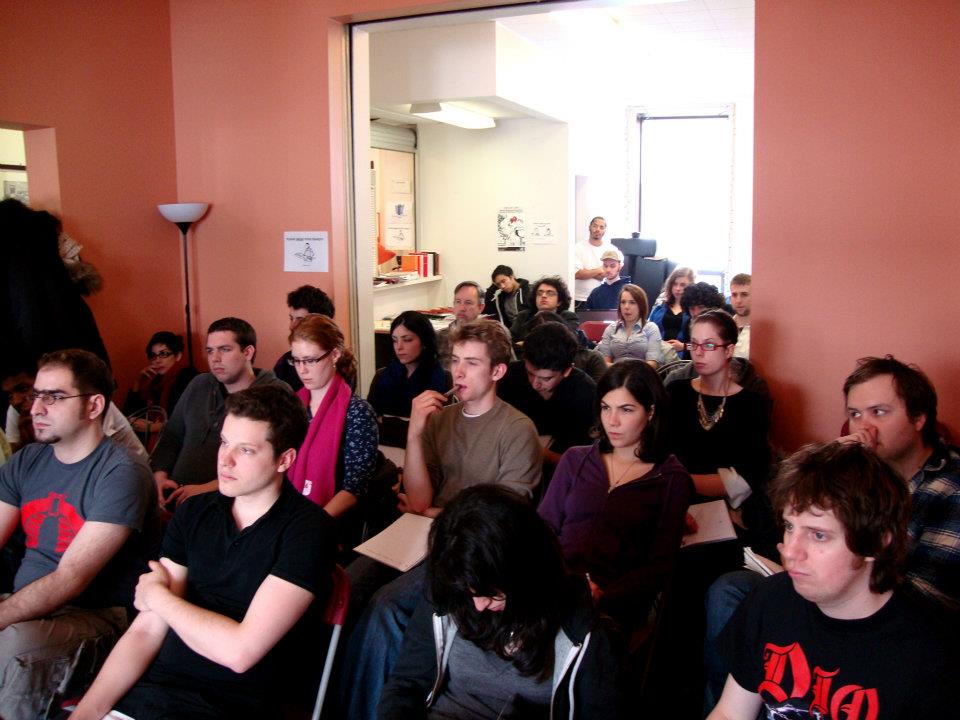
Over 50 comrades attended the second annual Northeast Marxist School in Montreal last weekend. Organized by supporters of La Riposte Quebec, Fightback Canada and Socialist Appeal USA, the school was a resounding success that saw a 30% rise in attendance from the previous year. Comrades from Toronto, Ottawa, Montreal, Boston, New York and New Jersey enjoyed two days of vibrant political discussion and revolutionary socials.

North American Marxist Winter School in Montreal
The most important lesson of the weekend was the pressing need for a revolutionary tendency with correct Marxist ideas to help the working class achieve its emancipation. This year’s sharp increase in attendance is a reflection of the revolutionary epoch we have entered.

Since last year’s school, which took place in the immediate wake of revolutions in Egypt and Tunisia, we have witnessed the wider Arab Spring, pre-revolutionary turmoil in Greece, and massive protest movements around the globe including the Spanish indignados, the Occupy movement and the anti-Putin protests in Russia. The inability of ruling classes to resolve the contradictions of capitalism have led to a global impasse. More and more workers and youth are turning to the ideas of Marxism in order to explain the world we live in and to present a viable alternative.

Arriving on Friday night to a social at the Jazz Hostel, comrades awoke early Saturday morning for a veritable two-day Marx-a-thon. Alex Grant from Fightback’s editorial board delivered the opening presentation, “Perspectives on the World Capitalist Crisis”, which briefly covered the broad historical movements of 20th century capitalism – its boom and bust periods, its contradictions leading to wars and revolutions – as a background for the new crisis we find ourselves in today.

The mass movements in the Arab world, Europe, Africa and North America illustrate that we have entered a tumultuous new period. The presence of all the objective factors for revolution is contrasted by the lack of an organized revolutionary tendency to harness the energy of the working class. If not addressed, this contradiction will play a tragic role in future developments.

Time limits prevented inclusion of some key topics in the lead-off, such as Latin America, but comrades in attendance were more than happy to fill in the blanks and provide their own perspectives during the subsequent discussion period. This was to be a recurring pattern throughout the weekend, as each participant drew upon their individual knowledge to raise the theoretical level of all.

After lunch, Camilo Cahis gave a lead-off on “Lessons of the Spanish Revolution”, a crucial struggle of the interwar period rife with lessons for today’s revolutionaries. The involvement of so many political tendencies in this struggle from 1931-1938 – Marxists, Stalinists, centrists, liberals, anarchists, fascists, conservative nationalists – renders study of the Spanish Revolution an indispensable primer on how the interaction of objective and subjective factors can make or break a workers’ revolution. Not coincidentally, Fightback just released a new booklet reprinting works of Leon Trotsky, Pierre BrouĂ©, and Ted Grant on the Spanish Revolution. These booklets were eagerly snapped up by attendees seeking more information.

The last session of the day was “The History of Marxist Organizing”, with Tom Trottier discussing the development of Trotskyist tendencies in the United States and Britain. He examined the strengths and weaknesses of prominent American Trotskyists, particularly James P. Cannon, and how the inability of the leaders of the Fourth International to absorb Trotsky’s method after his death led to a series of splits and muddled opportunistic positions in the ensuing decades.

Tom’s parallel history of the Militant tendency in Britain made the case that Ted Grant had a superior grasp of the Marxist method in his approach to organization and theory. Unfortunately, Militant was not immune to errors or objective factors that led to its eventual split. The importance of these lessons in building a new revolutionary tendency can be found in the old clichĂ© that “those who fail to learn from history are doomed to repeat it.”

As Saturday drew to a close, comrades adjourned to the Jazz Hostel for that night’s social. Despite the ostensible goal of unwinding after a long day, the quality of the presentations fuelled many in-depth political discussions over beer that evening, and a splendid time was had by all.

Refreshed comrades returned the next day to hear Mark Rahman from the US Workers’ International League give a presentation about “The Minneapolis Teamster Rebellion of 1934”, a pivotal Depression-era struggle that saw American Trotskyists play a key organizational role.

Joel Bergman from La Riposte (Quebec) gave a final presentation on Trotsky’s In Defence of Marxism, a compilation of letters and essays the “Old Man” wrote to his American followers in the 1930s. One of the most important lessons comrades absorbed was Trotsky’s use of the proper Marxist method. Unlike the Stalinists and sectarians who attempt to resolve political differences through organizational means such as expulsions, Lenin and Trotsky always attempted to use every dispute as a means of raising the general political level of the cadres.

The comrades capped off the weekend with raucous renditions of “The Internationale” and “Bandiera Rossa”. As the weekend school ended, enthusiasm among attendees was palpable. For the first time in decades, Marxists are no longer swimming against the tide. Not only do Marxist ideas make sense of current events – far more so than the confused commentary of the bourgeois media – but workers and youth are eager to hear them, as the Northeast school demonstrated.

The current crisis of capitalism is not going away anytime soon. In the absence of an organized revolutionary tendency, the capitalist system will continue to cause unspeakable horror and misery for the vast majority of the human race. Development of this subjective factor must be the primary focus for all Marxists going forward. This school played an important role in this development and helped build unity between revolutionaries in Quebec, Canada, and the United States.

Friday, February 10, 2012

Marxism, Ideology and Media "Objectivity"

"Having an ideology is not a sin but a sign of principles."
- Julian Benson

Marxism, like any analysis, assembles the available facts, draws connections, notes contradictions and tries to recognize patterns. But I would argue that as an analytical method, it is more rigorous than most.

One of the greatest myths of establishment media is that it is somehow objective. No one can be objective when unique life experiences inevitably shape and influence our views, yet corporate media figures continue to proclaim their status as "objective journalists" when they are anything but. Media bias is a common complaint from all ends of the political spectrum. The logical fallacy lies in the belief that media can ever be truly objective.

What do you think of as "objective" media? Probably what's in the newspapers, right? The Associated Press. I read AP stories every day. On one hand, it provides the blandest possible account of the relevant facts. On the other, there are scores of hidden biases surrounding each story that the reader rarely dwells upon. Why are they reporting on this story instead of that one? Why do they give more weight to official sources in our country than in the designated "enemy" country? Why are they painting this guy as the good guy and the other as the bad guy?

Our newspapers talk about human rights abuses in China or in Russia or Iran. Our politicians, they say, are so very concerned about human rights. But they never habitually mention the human rights abuses of our own governments as they do in stories about China or Iran. They don't talk about the disastrous effects of our wars of aggression or CIA torture camps.

Even so, the facts eventually get out. It's no big secret, the information is out there. Everybody knows the Iraq War was based on lies. People knew about the firebombing of Dresden and the bombing of Hiroshima. The question is why people accept these things. We're told by politicians, by the media, that state crimes were either necessary (in the case of destructive large-scale military actions) or aberrations (such as the Abu Ghraib prisoner abuse). And then we move on. The message is clear: we're still fundamentally good people and our governments represent us.


We might have political disagreements with our fellow citizens. The liberal point of view criticizes the excesses of big business, but never seriously challenges it. The conservatives worship big business, or want to reverse history and go back to a utopia of small businesses (libertarians). But this is the spectrum of acceptable political thought in the United States.

In America you can go pretty much as far right as you want, so long as you're not an actual fascist, neo-Nazi or KKK. Fox News will demonize liberals (which basically translates to "not conservative"), but otherwise you're pretty solidly in the mainstream. Social democrat - discouraged but tolerable. Socialist...hmm, okay, you're getting a little out there. You might even be "destroying America". But full-on Marxist? You're kidding! Are you crazy? Don't you know that communism doesn't work? "Everyone tells me that communism is evil, and after reading The Communist Manifesto once that's enough for me!"

It doesn't matter to such individuals if Karl Marx produced the most detailed analysis of the capitalist mode of production ever written. In terms of how he changed the way we look at ourselves, I can only compare him to Charles Darwin. Darwin revolutionized the way we looked at the natural development of species, including the evolution of humans. Marx revolutionized how we looked at the historical development of humanity and the evolution of societies.

We live in a capitalist economy. Everyone knows that, but Marxists think outside the box (as do anarchists, the Zeitgeist Movement and other anti-capitalists, though I would argue Marxism provides a superior theoretical framework). Mainstream economists are great at explaining what went wrong after the fact, not so great at predicting the future. The more successful ones are those who can keep the boom cycle going. People like Lawrence Summers, Timothy Geithner, Robert Rubin, Alan Greenspan. These economists win Nobel Prizes. When capitalism is in a boom period, they're feted as the Masters of the Universe.

But in an economic crisis, suddenly, there's nothing they can do. They're helpless to provide any solutions to the problems of capitalism within the framework of the current system. Unemployment in the United States today is a national emergency. So is the wave of home foreclosures. But this is not a priority of the government, which is all about more war and lower corporate taxes while somehow cutting the deficit and paying back the bankers. It's insane, and the inevitable result of such insane policies is that the debt has to be paid off on the backs of workers through massive cuts and layoffs.

You won't hear that explicit view in the mainstream media. They don't provide any real solutions to the crisis. This is the central contradiction in class society: between the desires of the masses and the desire of a tiny elite. And you never hear about it in ruling class media, at least until the Occupy movement forced the issue.


You will hear it in Marxist tracts. And yet somehow, the Marxists are criticized for not being objective? The so-called "objective" news sources can't paint an objective picture of how the world economy really works?

I make no pretensions to objectivity. As a Marxist, I advocate a specific point of view: for the interests of the working class. And those interests are very concrete: good housing, well-paying jobs, education, pensions, health care, free time and yes, consumer goods. Doesn't everybody want these things?

Yet workers more and more have to fight to fulfill those basic needs, because under the wage system, they are a) always at the mercy of their employers, b) shortchanged in pay which accrues as profit to the capitalist, and c) far more likely to suffer in an economic downturn.

If I link to an article from the International Marxist Tendency, I do not claim it to be "objective". I merely think it correct from the standpoint of revolutionary Marxism.

People need to get past the view that ideology is bad, because there is a sharp difference between merely having an ideology and being an ideologue.

Sunday, July 17, 2011

In Defence of Marxism

From a recent exchange on Facebook.

A Facebook-friend of a friend made the following remark during a discussion about the Greek debt crisis:

Marxist theory is hopelessly shallow in its perception of how people see themselves. Very few identify as "working class" or "bourgeois" but many would escribe themselves as "Canadian" or "humanist" or "young," "Muslim" or "father." Class identity is important but not all-important.
My response:

Marxists explained a long time ago that there is no final crisis of capitalism - the bourgeoisie will always find a way out until the working class takes power into its own hands.

Please excuse the Marxian terminology (you might say jargon), but it's the most accurate way for describing the broad movements of the economy in terms of who actually produces the wealth (workers). Marxism is actually much more complex than the simple dichotomy of "bourgeoisie/proletariat". It allows for the petty bourgeoisie (small business owners and professionals), lumpen-proletariat (swindlers, criminals, beggars, those on the margins of society), peasants if there are any. And that's just in recent history - in earlier times there were different classes - freeman/slave, lord/serf, etc. As a way of sketching out the broad class formations in social relations, Marxist theory is indispensable.

But Marxism doesn't JUST talk about class. That's an understandable misconception. Like any good method of analysis, it takes into account as much information and facts as possible, including gender, race, nationality, and so on. At the same time, it realizes that class is ultimately the determining factor when it comes to actual change of the social order. What we think of as "the middle class" is actually the working class that is enjoying the benefits of past struggles - for the 8-hour work day, overtime pay, pensions, collective bargaining rights. All these are now being taken away from us. Why? Because capitalism is in crisis worldwide.

It's only a Greek problem? Wrong. (Just ask the Wall Street Journal.) When Greece defaults - and it will, no matter what austerity measures are put in place - we'll get defaults in Ireland and Portugal, followed by a financial crisis in Spain, dragging the whole of Europe and the United States into it. French and German banks have the most to lose from a Greek default, which is why their governments are pushing for bailouts of the debtor nation.

The problem is, these kinds of periodic crises are endemic to the capitalist system, and even its most ardent defenders will admit that. Duh - boom and bust, right? Everybody knows a capitalist economy will have recessions and depressions. BUT: It's only the people who win under capitalism that are cushioned from the effects. The working majority always lose out.

Why is there massive unemployment that just seems to get worse all the time? Why are people with jobs being forced to work longer hours for less pay and benefits? Why are governments cutting social services everywhere? I live in Toronto and our mayor wants to cut the budget of all departments by 10%, including the fire department. Why is all this happening? Because this kind of thing always happens when the capitalist party ends and the working class gets the hangover ("Wall Street got drunk" - George W. Bush). Bankers blew a hole in the global economy. They, along with other corporations and the wealthy, control our governments (the Golden Rule - "he who has the gold makes the rules"), and now they want to make the working class pay for a crisis they caused.

The media constantly chirp about a recovery. In truth, the long postwar economic boom has been pushed far past its shelf life through increased debt. A little fast history: capitalism was effectively pulled out of the Great Depression by World War II, which served as an artificial stimulus to a massive armaments boom. The technologies that emerged from the war and the new markets opened up to the United States led to a long economic boom that started to plateau in the late 60s and stagnated in the 70s. As a reaction, the deregulation of the 80s and development of ever more exotic financial securities led to the ever-increasing financialization of the economy and to a large extent de-coupled financial markets from the "real" economy. (Stocks numbers are great right now, employment figures not so much.)

Over the last 30 years of reaction, workers' wages stagnated while the bosses' have skyrocketed (this was partly masked by greater consumer debt). Income inequality is worse than ever, and there seems to be no real recovery in sight. This is not a matter of me reading a Marxist book and thinking about rrrrrevolution! It's about being sick of a system that's left our world a stinking impoverished mess. I'm sick of the wars, inequality, the hunger, the environmental degradation, the national rivalries and racism - and the system of private profit at the root of it all.

People react strangely to the term "dictatorship of the proletariat", because they associate the first word with individual tyrants. In fact, it just means power, and it makes a lot more sense if you consider that right now we live under the "dictatorship of the bourgeoisie". Ever get the feeling that your vote doesn't matter? In some ways, it doesn't - not when the game is rigged and the same people are pulling the strings no matter who gets elected to office. If you want to describe who those people are, bourgeoisie is as good a term as any.

One last point I want to make, and I congratulate anyone who's made it this far. I used to think that the idea of two classes, the bourgeoisie and the proletariat, duking it out was an antiquated 19th century notion. I hope I've absolved you of any confusion there. When Marxists talks about the "working class", people tend to think about workers in factories. But it's really about producing surplus value (i.e. goods and services), and the tools and machines you use to make those (if any) don't really make a difference. So that includes service jobs, like working at Wal-Mart or being a waitress. It includes white collar office jobs and blue collar industrial jobs. Basically, it's anybody who earns a wage for a living.

Marxists don't back the working class because of some romantic idea of what it means to be a worker or because we think they're great people. We support them because they are the only class capable of transforming society - in the first place, by shutting it down.

If Richard Branson or Bill Gates goes on strike for a year...who cares? But if there's a general strike for just one day, everything stops. Nothing can get done, nothing can be produced. You'll notice that in Egypt, it was only when the Egyptian working class mobilized - when we saw strikes in factories, among unionized workers of all kinds - that Muburak was finally pressured to step down. Essentially, if you're sick of the world we live in right now, there's only one group in society that can change that: the international working class. Workers in Egypt have more in common with workers in Canada than either of us have with our elected national "leaders".

Monday, November 9, 2009

Chairman Mao's Greatest Hits

Just finished reading Quotations From Chairman Mao Tsetung (aka the Little Red Book). I first became interested in reading Mao's book after watching a documentary on the origins of the Black Panther Party, whose founder Huey Newton cited it as a key blueprint for the party's programme in the 1960s. While the Panthers were facing somewhat different circumstances than the broader masses of today - i.e. with American blacks just emerging from a century-long period after the Civil War in which their status as second-class citizens had become officially enshrined through Jim Crow and segregation, which thereby necessitated a greater role for racial solidarity in the movement than might otherwise have been the case - I was nevertheless inspired by the presence of a radical North American socialist movement that achieved such high visibility during its short existence.

I had always generally viewed Maoism as a distortion of Marxism, akin to Stalinism. Mao's emphasis on the peasantry always smacked to me of trying to square a circle; for Marx, socialism could occur only in developed capitalist countries with a large industrial working class. Furthermore, Mao's grotesque failures of statesmanship, most notably the Great Leap Forward and the excesses of the Cultural Revolution, seemed to indict him as a Stalinesque tyrant who gave communism a bad name. Still, the Panthers seemed to get some use out of his works, and I had heard that Mao was still admired as a philosopher and poet in a modern China that has otherwise moved on. Could there be more to Mao than I first assumed?

After finding a copy of the Little Red Book in my local library, I carried it everywhere I went (such are the perks of its small, deliberately portable size) and read most of it on the city bus. Having finally reached the end of its surprisingly dense 312 pages, I've walked away fairly impressed. Were it not for the knowledge that Mao's policies led to the deaths of up to 70 million Chinese in peacetime, I would be fairly quick to heap praise on this book. The numerous quotations tackle all kinds of issues and is probably the only practical guide out there for launching a communist revolution. Mao's conclusions can be highly questionable, his ideology controversial and his adherence to his own advice often dubious, but I have no doubt that the book certainly presents some food for thought.

Here, then, are some of my favourite quotes from the book and my reactions to them:

"It is up to us to organize the people. As for the reactionaries in China, it is up to us to organize the people to overthrow them. Everything reactionary is the same; if you don't hit, it won't fall. This is also like sweeping the floor; as a rule, where the broom does not reach, the dust will not vanish of itself."
- "The Situation and Our Policy After the Victory in the War of Resistance Against Japan" (August 13, 1945), Selected Works, Vol. IV, p. 19.


A simple yet often overlooked truth. The task of waging a people's revolutionary movement is no walk in the park, but even having the will of the people carried out by Parliament or Congress has proven to be a Herculean task in the bourgeois democratic system. In today's system, especially given the past three decades of neoliberal advances, money rules all. The place to start is by fighting against all reactionary ideas and moving on from there.

"The enemy will not perish of itself. Neither the Chinese reactionaries nor the aggressive forces of U.S. imperialism in China will step down from the stage of history of their own accord."
- "Carry the Revolution Through to the End" (December 30, 1948), Selected Works, Vol. IV, p. 301.


Similar to the previous quote, Mao here reminds us again that the instinct of every entrenched elite is to protect its own power. Such has been the situation in every historical system of government, from the British monarchy to the Iranian theocracy, from the Soviet apparatchiks to the modern-day corporate oligarchies, and any truly revolutionary impulses will be viciously opposed by the rulers, if necessary through violent repression. Knowledge of this fact leads us to the eternal debate, so eloquently summarized by Malcolm X, between the ballot and the bullet.

"A revolution is not a dinner party, or writing an essay, or painting a picture, or doing embroidery; it cannot be so refined, so leisurely and gentle, so temperate, kind, courteous, restrained and magnanimous. A revolution is an insurrection, an act of violence by which one class overthrows another."
- "Report on an Investigation of the Peasant Movement in Hunan" (March 1927), Selected Works, Vol. I, p. 28.


Here Mao stops beating around the bush and unambiguously states the nature of revolution, which in his mind requires violence in order to forcibly overthrow the ruling class. This may be the most controversial idea in Marxist theory, and has historically divided those on the left who believe it is possible to substantially improve the lives of the working classes by working within the confines of the parliamentary system (like the Russian Mensheviks, the Canadian New Democrats, or European labour parties before the neoliberal era) from those who believe only violent revolution can lead to the end of capitalism (as thought the Bolsheviks, the Communist Party of China, and most Trotskyist groups). For me, this remains an uncertainty. I have always maintained pacifistic tendencies and tend to frown on violence, but I must admit that the powerful more often than not are willing to resort to force, and in this way they assert their dominance over the weak. Can it therefore be the case that only violence will defeat a ruling class that, aside from its hoarding of public wealth, is most notorious for its addiction to state violence? I remain indecisive, but Mao has no such qualms:

"Revolutions and revolutionary wars are inevitable in class society, and without them it is impossible to accomplish any leap in social development and to overthrow the reactionary ruling classes and therefore impossible for the people to win political power."
- "On Contradiction" (August 1937), Selected Works, Vol I, p. 344.


Debatable. Don't forget that the China of 1937, like Russia in 1917, was a country that had no real experience with liberal democracy and had been ruled by autocrats for centuries (in the case of China, millennia). It could be argued that in a liberal democratic system with appropriate checks and balances, or a direct democracy akin to the ancient Athenians, a sufficiently energized, motivated and educated population could win political power merely through exercising the power of the ballot box. However, it must be noted that even the most progressive capitalist governments, like FDR's New Deal Democrats, are only willing to be pushed so far by giving in to workers' demands for certain reforms. Any push to actually abolish capitalism and replace it with a dictatorship of the proletariat would necessarily infringe on the property and power of the ruling classes and would therefore be repelled by the full armed might of the bourgeois state. So perhaps Mao is right on this point, as long as you're a communist and not merely seeking an end to child labour or a 40-hour work week.

"History shows that wars are divided into two kinds, just and unjust. All wars that are progressive are just, and all wars that impede progress are unjust. We Communists oppose all unjust wars that impede progress, but we do not oppose progressive, just wars. Not only do we Communists not oppose just wars, we actively participate in them. As for unjust wars, World War I is an instance in which both sides fought for imperialist interests; therefore the Communists of the whole world firmly opposed that war. The way to oppose a war of this kind is to do everything possible to prevent it before it breaks out and, once it breaks out, to oppose war with war, to oppose unjust war with just war, whenever possible."
- "On Protracted War" (May 1938), Selected Works, Vol. II, pp. 152-53.


I probably agree with the first two sentences, although they are blanket statements. Anyone who has truly experienced war (as Chris Hedges wrote in War is a Force That Gives Us Meaning) knows that all the abstract proclamations of patriotism and just cause go out the window when the bombs start going off and you have to frantically reassure your best friend he'll be okay even as his intestines pour out of a gaping wound. No matter what the cause or supposed justification, war is a bloody, unpredictable affair that inevitably dehumanizes all it touches.

At the same time, anyone familiar with history, or who has merely interacted with other people, knows that aggression and violence have always been a part of the human condiction. Sometimes there are bullies, psychos, criminals and killers who initiate aggression, and in that case the rational response must be to meet violence with violence, if only to save one's life. Expanded to the larger scale of full-out warfare, the same principle holds. If Nazi Germany embarks on a campaign of annihilation to exterminate the people of the Soviet Union and destroy the state as a political entity, the people can fight, or perish. In that case, then, Mao is right - the Soviet people were truly fighting a just war. Nevertheless, that abstract knowledge can never compensate for the sheer brutality of war, the destruction it causes and the tragedies it imparts on its countless human victims.

"Can a Communist, who is an internationalist, at the same time be a patriot? We hold that he not only can be but must be. The specific content of patriotism is determined by historical conditions. There is the "patriotism" of the Japanese aggressors and of Hitler, and there is our patriotism. Communists must resolutely oppose the "patriotism" of the Japanese aggressors and of Hitler. The Communists of Japan and Germany are defeatists with regard to the wars being waged by their countries. To bring about the defeat of the Japanese aggressors and of Hitler by every possible means is in the interests of the Japanese and the German people, and the more complete the defeat the better. [...] For the wars launched by the Japanese aggressors and Hitler are harming the people at home as well as the people of the world. China's case, however, is different, because she is the victim of aggression. Chinese Communists must therefore combine patriotism with internationalism. We are at once internationalists and patriots, and our slogan is, 'Fight to defend the motherland against the aggressors.' For us defeatism is a crime and to strive for victory in the War of Resistance is an inescapable duty. For only by fighting in defence of the motherland can we defeat the aggressors and achieve national liberation. And only by achieving national liberation will it be possible for the proletariat and other working people to achieve their own emancipation. The victory of China and the defeat of the invading imperialists will help the people of other countries. Thus in wars of national liberation patriotism is applied internationalism."
- "The Role of the Chinese Communist Party in the National War" (October 1938), Selected Works, Vol. II, p. 196.


A well-argued case for a war that truly was one of necessity, unlike Barack Obama's laughable characterization of the war in Afghanistan in that manner. Having read Iris Chang's account of the Rape of Nanking, I know that the horrors of Japanese rule in China could only be combatted by full-scale war against the aggressors, and in that regard Mao does a fine job in this quote of reconciling the Marxist doctrine of internationalism with the nationalist feelings inherently created by war.

"The Communist Party does not fear criticism because we are Marxists, the truth is on our side, and the basic masses, the workers and peasants, are on our side."
- Speech at the Chinese Communist Party's National Conference on Propaganda Work (March 12, 1957), 1st pocket ed., p. 14.


Hard to reconcile with the Cultural Revolution and its demonization, torture and execution of those who did not follow the proper Maoist line, but a good thought for 21st century Marxists who wish to wipe the slate clean and build a new people's movement.

"Conscientious practice of self-criticism is still another hallmark distinguishing our Party from all other political parties. As we say, dust will accumulate if a room is not cleaned regularly, our faces will get dirty if they are not washed regularly. Our comrades' minds and our Party's work may also collect dust, and also need sweeping and washing. The proverb 'Running water is never stale and a door-hinge is never worm-eaten' means that constant motion prevents the inroads of germs and other organisms. To check up regularly on our work and in the process develop a democratic style of work, to fear neither criticism nor self-criticism, and to apply such good popular Chinese maxims as 'Say all you know and say it without reserve', and 'Blame not the speaker but be warned by his words' and 'Correct mistakes if you have commited them and guard against them if you have not' - this is the only effective way to prevent all kinds of political dust and germs from contaminating the minds of our comrades and the body of our Party."
- "On Coalition Government" (April 24, 1945), Selected Works, Vol. III, pp. 316-17.


I admire Mao's idea of self-criticism as a way to prevent rigid dogmatism from dominating party policy, but unfortunately China's own experiences during his rule illustrated that Mao had a much different attitude towards criticism that was directed at him personally.

"Both dogmatism and revisionism run counter to Marxism. Marxism must certainly advance; it must develop along with the development of practice and cannot stand still. It would become lifeless if it remained stagnant and stereotyped. However, the basic principles of Marxism must never be violated, or otherwise mistakes will be made. It is dogmatism to approach Marxism from a metaphysical point of view and to regard it as something rigid. It is revisionism to negate the basic principles of Marxism and to negate its universal truth. Revisionism is one form of bourgeois ideology. The revisionists deny the differences between socialism and capitalism, between the dictatorship of the proletariat and the dictatorship of the bourgeoisie. What they advocate is in fact not the socialist line but the capitalist line. In present circumstances, revisionism is more pernicious than dogmatism. One of our current important tasks on the ideological front is to unfold criticism of revisionism."
- Speech at the Chinese Communist Party's National Conference on Propaganda Work (March 12, 1957), 1st pocket ed., pp. 26-27.


Honestly, this passage struck me as Obamaesque, and not in the ludicrous, Glenn Beck-inspired Obama-is-a-communist teabagger claptrap way, but rather in the method by which it reveals Mao as a politician trying to appeal to all sides, and in that regard saying things that are very broadly agreeable within the context of whoever his audience is. Whereas Obama's style is "conservatives say x, liberals say y, why can't we just all get along and find some common ground?", Mao's goes, "revisionists are too far in the direction of x, dogmatists are too far in the direction of y. We can't go too extreme in either direction." The desire of politicians to please everybody is apparently more universal than I thought.

" 'Don't you want to abolish state power?' Yes, we do, but not right now; we cannot do it yet. Why? Because imperialism still exists, because domestic reaction still exists, because classes still exist in our country. Our present task is to strengthen the people's state apparatus - mainly the people's army, the people's police and the people's courts - in order to consolidate national defence and protect the people's interests."
- "On the People's Democratic Dictatorship" (June 30, 1949), Selected Works, Vol. IV, p. 418.


A fine idea, but the problem is that power corrupts and institutions originally designed to serve "the people" have a way of being corrupted over time by a calcifying elite that equates its own interests with those of the masses even what that is no longer the case (as it rarely is when an elite exists at all). Every government will claim that it serves "the people", and checks and balances must be maintained to ensure that power does not merely return to a new, different elite. The "democratic centralism" of China and the USSR is now widely viewed as an anachronism, a failed experiment that claimed to represent the will of the people but merely perpetuated the power of the Communist Party. A new, 21st century socialism should perhaps embrace a more decentralized model.

"Every Communist working in the mass movements should be a friend of the masses and not a boss over them, an indefatigable teacher and not a bureaucratic politician."
- "The Role of the Chinese Communist Party in the National War" (October 1938), Selected Works, Vol. II, p. 198.


Good advice...too bad it didn't work out in real life. Maybe next time?

"Communists must never separate themselves from the majority of the people or neglect them by leading only a few progressive contingents in an isolated and rash advance, but must take care to forge close links between the progressive elements and the broad masses. This is what is meant by thinking in terms of the majority."
- "The Role of the Chinese Communist Party in the National War" (October 1938), Selected Works, Vol. II, p. 198.

"We Communists must be able to integrate ourselves with the masses in all things. If our Party members spend their whole lives sitting indoors and never go out to face the world and brave the storm, what good will they be to the Chinese people? None at all, and we do not need such people as Party members. We Communists ought to face the world and brave the storm, the great world of mass struggle and the mighty storm of mass struggle."
- "Get Organized!" (November 29, 1943), Selected Works, Vol. III, p. 158.


Nice notes to end on, because I'm getting tired of writing and let's face it, you should just check out the book for yourself. Still, it strikes a crucial point for me personally, as well as other left-leaning bloggers in the information age - namely, that revolution doesn't happen in a vaccuum. If you want to change the world, you have to go out and spread your thinking, educate the people, and form a united front in actuality, not just as an academic exercise. Hopefully I can play a greater part than just writing rants on this blog, but only time will tell.

In the meantime, if you've made it this far, I'll leave you with an entirely unrelated quote by a very different political philosopher, whose point of view is less dogmatic and much funnier. Ladies and gentlemen, the late, great George Carlin:

"If lobsters looked like puppies, people could never drop them in boiling water while they're still alive. But instead, they look like science fiction monsters, so it's OK. Restaurants that allow patrons to select live lobsters from a tank should be made to paint names on their shells: 'Happy,' 'Baby Doll,' 'Junior.' I defy anyone to drop a living thing called 'Happy' in rapidly boiling water."
- Brain Droppings (1997), p. 71.