Showing posts with label Dalton McGuinty. Show all posts

Monday, November 22, 2010

Hamilton Steelworkers Fight U.S. Steel Lockout

Originally posted at Fightback.

On November 7, US Steel locked out over 900 employees at its Hamilton plant. This followed failed attempts to bypass the union and directly force workers to vote on pension cuts dictated by corporate headquarters. United Steelworkers Local 1005 argued that the company was negotiating in bad faith, noting that it had activated two blast furnaces in US plants while shutting down production at the Hamilton mill, and refused to hold a vote.

Citing “the current economic landscape and Hamilton’s status as one of the most challenging steelmaking facilities in all of North America,” the company ordered workers to vote on its final offer, which included two key demands: an end to the indexing of pension payments for its 9,000 retired workers, and refusing new hires the existing pension plan by replacing it with a defined contribution retirement savings plan.

Pension indexing was negotiated as part of the 1990 contract between the former Stelco (bought out by US Steel in 2007) and the United Steelworkers. It makes payments ranging from between zero and three per cent based on an equation that balances the performance of Stelco pension plans against cost-of-living increases—in essence, increasing pension payments to adjust for inflation. That slight increase is crucial, since inflation can quickly erode the value of workers’ pensions.

As noted by the Hamilton Spectator, while direct benefit plans pay retired workers a set pension per month, direct contribution plans pay according to how much money has been saved and how much has been earned in investments. “Direct contribution plans also don’t require the employer to ensure there’s enough money in the pension plan to meet all former obligations if the company goes out of business. That’s important for US Steel because the former Stelco plans are underfunded by about $1.2-billion.”

Employees at the US Steel plant in Hamilton are almost evenly divided by age, with approximately half of workers under 50 and half over 50—the result of skewed hiring practices in past decades. The US-based steel conglomerate is exploiting those divisions by attempting to pit young workers against old. As union representatives commented, allowing 900 active workers to decide the fate of 9,000 retired employees' pensions would be a cruel mockery of democratic norms.

Pensions are less of a concern for younger employees, who are more likely to bow to company demands rather than face an indefinite lockout and attempt to feed their families on strike pay of $200 per week. In addition, Local 1005 received a letter confirming that health benefits (prescription drugs, medical, dental, and vision), life and disability benefits had been temporarily suspended for all active Bargaining Unit members as of November 8. Management may be banking on a similar outcome as occurred in its Lake Erie plant in Nanticoke, where workers eventually acquiesced to identical pension cuts after an eight-month lockout.

Adding insult to injury, US Steel only three years ago made extravagant promises to workers that its acquisition of Stelco would not affect their livelihoods. The irony is too much to bear reading the letter today, dated 28th September 2007 and headlined “Stelco’s Pensions Safe with U.S. Steel”:

We would like to clear up any confusion and relieve any concerns Stelco’s employees and pensioners may have about the security of their pensions on the closing of our transaction to buy Stelco. U.S. Steel has agreed to significantly improve the security of the Stelco pension plans. We did so in two ways. First, we agreed to unconditionally guarantee pension funding obligations at the corporate (as opposed to Canadian subsidiary) level. Thus, instead of having to rely solely upon Stelco's ability as a stand-alone enterprise to generate the cash necessary to meet pension funding obligations, Stelco's employees and pensioners can now look to the strength of our entire company to do so. Second, we agreed to make an extraordinary payment of $32.5-million into the plans up front at closing. This is in addition to the pension payment schedule agreed upon by the Ontario pension regulator and Stelco.

[...]

Of course, all laws that presently apply to Stelco will continue to apply, as will all other provisions of the Stelco pension agreement, including those provisions requiring pension contributions to fully fund Stelco’s pension plans by 2015. We want Stelco’s employees and retirees to know that we understand the fundamental importance of sound pension funding. We have a large defined benefit pension plan for decades. We take our obligations very seriously and are proud of the fact that today that plan is fully funded. In fact, over the last four years, we have made over $700 million in voluntary contributions to that plan. We will honour our commitment to the Stelco pension plans. That is our history and track record.

Some track record!

In an article for the Hamilton Spectator, retired Stelco treasurer Robert H. Thompson argued that three critical macroeconomic factors outside the labour dispute contributed to the lockout decision.

First, the rising value of the Canadian dollar against a declining American dollar, helped in part by large Canadian energy exports, has wiped out any competitive advantages formerly held by Canadian industry. Second, the decimation of Ontario’s manufacturing base in recent years has severely decreased the amount of potential customers for Hamilton steel products; for example, fewer Ontario automobile plants means less demand for steel. Finally, Hamilton Works is less technologically-advanced than the company’s other plants. As a result of mill closures over the past decade (plate mill, strip mill), there is nowhere to process fresh slabs of steel, which must be shipped to other US Steel plants for processing.

However long the lockout lasts, its economic impact on Hamilton and surrounding areas promises to be devastating. 900 employees currently work at Hamilton Works, down from a peak of 13,000 in previous decades, but the lockout will also affect supporting industries and drastically lower the amount of raw materials flowing through Hamilton’s port. Aside from the loss of high-paying manufacturing jobs, Thompson estimates the city faces up to $1-billion in lost revenue.

Nor can the symbolic impact on Canadian workers be underestimated. Having tasted blood with their successful effort to overturn pension agreements at the Lake Erie plant, the bosses are now determined to set a precedent in Hamilton and break the union. Members of Local 1005 USW harbour no illusions about the company’s intentions.

“A foreign monopoly called US Steel has come into our corner of the earth and with utmost arrogance is dictating to Canadians that we should ‘be realistic,’” reads a recent Local 1005 information update. “To prove the union is not ‘completely unrealistic’ it is supposed to serve ‘American manufacturing and trading interests and policies.’ It is supposed to follow U.S. ways of ‘fend for yourself’ and agree to an endless downward slide in living and working conditions.”

The nationalistic undertones of the workers’ protest, epitomized by slogans such as “Yankee Go Home,” are understandable but misplaced. US Steel is a US-based multinational with significant reserves to ride out a lengthy lock-out. They want to make an example of the Hamilton workers not just to push down conditions in Canada, but also internationally. Here we see that the interests of workers in Canada are united with the interests of workers internationally, including in the United States. We may also note that the interests of the bosses are also united in the US and Canada. Therefore, rather than utilizing nationalist slogans that divide Canadian and American workers, wouldn’t it be better instead to strengthen those bonds of workers’ solidarity?

To replace the lost production in Hamilton, two new furnaces have been fired up in the USA. It is possible that these plants are unionized, perhaps even with the USWA. Hamilton steelworkers should send delegations down to these mills to explain that whatever concessions are squeezed out of Canadian workers will in turn be demanded of American workers. This brings to mind the fantastic solidarity movement around the Liverpool dock-workers in the 1990s. Every scab ship that loaded in Liverpool, England, was followed around the world by workers who set up picket lines on the East Coast, West Coast, and other international ports. The longshoremen refused to cross what Billy Bragg called “The World’s Longest Picket Line” in a song celebrating the struggle. With an internationalist appeal those two extra furnaces could be shut down and real pressure can be put on the multinational corporation.

Workers have appealed for help from Canadian politicians but have received little in return. Nothing illustrates this claim better than the pathetic performance of federal Minister of Industry Tony Clement, who was quoted by the Hamilton press as saying, “There’s nothing the federal government can do...The Pittsburgh-based steelmaker is free to do whatever it wants...They can make decisions, good, bad, or indifferent, according to their own timetable and their own sensibilities.”

Conservative cries of federal impotence were matched provincially by the odious Dalton McGuinty. When the Ontario premier visited Hamilton last week to announce 300 new green jobs courtesy of Liberal donors JNE Consulting Inc., locked-out steelworkers waited outside the building to confront McGuinty and demand that he guarantee pensions of the 9000 retired Stelco employees by forcing US Steel to the bargaining table. In a cowardly, but entirely typical display, the premier avoided the workers by using an alternative entrance, later blaming that gutless decision on his security detail.

Ontario NDP leader Andrea Horwath, alone among provincial and federal party leaders, visited the picket line on November 10 to support the steelworkers. She noted that since the provincial government lent Stelco $150-million to deal with its pension solvency issues, gutting the pension funds of former, current, and future Hamilton steelworkers was “unacceptable.” Horwath urged McGuinty to take action by supporting workers’ rights to pensions against the dictates of powerful multinationals. The Liberal premier responded with a characteristically weak and non-committal response, arguing that both sides have a responsibility to settle the issue through mediation. With this effective capitulation, he chose to ignore the vast differences in resources between a multinational conglomerate worth billions of dollars and a determined band of 900 steelworkers.

This struggle is important for a number of reasons, not least of which is the historical militancy of USW Local 1005. The local has been at the forefront of the fight for decent pensions, against manufacturing job losses, and in solidarity with the oppressed. A number of the local’s executive members consider themselves Marxists, including Local President Rolf Gerstenberger, who is also a prominent member and vice-president of the Communist Party of Canada (Marxist-Leninist). When Stelco was under bankruptcy protection before the US Steel takeover, Gerstenberger called for the nationalization of the company and the development of some form of economic planning.

While we at Fightback are wary of any appeal to Canadian nationalism rather than the international solidarity of the workers’ movement, Gerstenberger’s proposal is nevertheless more inspiring than the impotent declarations of Big Business and the politicians they own, who claim that “market forces” are to blame and that nothing can be done but to brutally decimate the labour force and wait for these abstract conditions to improve.

If the subservience of bourgeois politicians like Tony Clement to the whims of U.S. Steel is an indication of the global solidarity of the capitalist class, it also reminds us of the common plight shared by the international working class. Just as all Canadian workers must see their own struggle in the fight of the Hamilton steelworkers, all workers of the world must view their seemingly isolated battles in a larger context. In this epoch of capitalist austerity, all of the gains made by workers in the post-war period are in danger. With militancy and international solidarity we can hold these cuts at bay—but only by fighting for socialism and nationalizing the commanding heights of the economy under democratic workers’ control and management can we end these attacks forever.

Sunday, July 4, 2010

In The Belly of the Beast: My G20 Experience

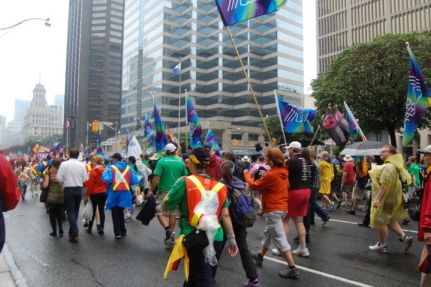
It had been, I felt, a productive day of protest. Thousands of people had defied the rain on this gray Saturday, June 26, 2010 to vent their rage against the global corporate elite as its leading representatives met in Toronto for the G20 summit. My friends and I took advantage of a free bus ride offered in Kingston by the Public Service Alliance of Canada (PSAC) to make our way to the T-dot that weekend, and what I had seen so far had left me deeply moved. The sheer size of the turnout was impressive, especially given the poor weather, and seeing so many passionate activists engaged in that most basic and essential of democratic activities - grassroots protest - was a powerful rebuttal to any suspicions I might have had that the Canadian public was too lethargic to get out in the streets and make its voice heard.


True, there had been some worrying signs after the masses assembled in Queen's Park and peacefully marched down University Avenue. We had seen a young man with his hand over an eye, blood running down his face, as his comrades ushered him through the crowd and cried out for a medic. Maybe he got in a cop's face, we thought. Eventually the protesters found themselves blocked off by a line of police at Queen Street East. The 5-0, decked out from head to toe in their latest quasi-fascist militarized police togs, shields raised and batons ready, may have been an intimidating presence, were it not for a crowd that refused to let itself be intimidated. A drum circle directly in front of the line provided a defiant flow of tribal beats; animal rights activists defended the sanctity of all life on this planet while I got my picture taken with a girl dressed up as a giant gray seal (a moment recorded for a TV update on Global News). When the cops took a menacing step forward, a girl cried out, "Sit down! They can't move us back if we're sitting down!" I grabbed my friend's megaphone and further spurred the crowd on to a sit-down protest - "the easiest form of protest", I declared - and the police were stopped in their tracks.


We experienced one unsettling moment when the police were ordered to don their gas masks. "Put on your bandanas!" yelled people in the crowd. As one officer perched high and aimed his riot gun menacingly at the protesters, we saw signs of tear gas in the air behind us. Yet for this afternoon, on this particular street, the crowd seemed safe for the time being. After a while, my friends and I decided to grab a bite at a Vietnamese restaurant and eventually found our way to Kensington Market, where we rented a room at a backpackers' hostel. Taking a breather, we switched on the TV for an update on how the Canadian media was reporting what we had just seen.

There was zero resemblance between the two narratives. What the CBC News Network, like the others, aired over and over was a single shot of a police car burning, sandwiched in-between footage of black-clad protesters smashing in the windows of banks and a Starbucks. There was no reporting whatsoever on what the protesters had actually been saying - i.e. what they were protesting against, or the myriad progressive solutions they put forth. Rather, there was a generic focus on "violent protesters", alarmism over the "anarchists" that had apparently swarmed the city, and an overall narrative that purported to offer all the necessary justification for Stephen Harper's $1.3 billion in security costs.


From this moment on, the dominant voices of the Canadian establishment completely submerged the voices of the protesters and drowned them in a sea of media-inspired agitation over the anarchist mob. I had seen members of the so-called Black Bloc as we filed out of Queen's Park: a wave of young people clad completely in black walking past me with bandanas covering their faces. It quickly became apparent that these people represented the outer boundaries of protest tactics - willing to go where the larger mass of people did not. The majority of the marchers I saw wielded a more subtly effective weapon: words. Chants of "peaceful protest" and "this is what democracy looks like" interspersed with "this is what a police state looks like" made clear the protesters' essentially Gandhian approach while maintaining a full-blooded stance of anger at the corporate elites who have plundered and poisoned our planet, destroyed the Canadian manufacturing base, pushed for bloody wars of imperial conquest all while relentlessly punishing the poor for the crimes of the wealthy bankers who crashed the world economy.


The most telling quote I heard the whole weekend came from an older gentleman beside me who faced down the line of police at University and Queen and asked a question as simple as it was profound: "What are you afraid of?" he demanded to know.

The answer, if you want it, is right here. But to summarize: the massive turnout of the police and tightening of the security apparatus was not simply about protecting the delicate ears of the G20 leaders. Rather, it was a dress rehearsal for the suppression of working class revolt by the Canadian capitalist elite, which fears the legitimate rage of a population facing long-term unemployment, endless war and looming ecological disaster. In this powder keg atmosphere, the corporate-financial elite is determined to hang on to its remaining privileges and power by any means necessary, including (as that formulation inevitably does) naked physical force.

You don't have to be a conspiracy theorist to find something very fishy in Black Bloc protesters managing to set multiple police cars on fire and break store windows in a city virtually under martial law, with over 5000 police officers patrolling downtown Toronto alone. I walked those city streets myself and you could not walk more than 25 metres without passing a cop. The idea that police would leave squad cars alone in this environment is difficult to believe, and leaves open the possibility that the Black Bloc was infiltrated by police provocateurs who incited and/or led the destruction of property in order to justify a brutal crackdown on the protesters. Such a suggestion is not fantasy; there is well-documented precedent for just such infiltration. After the images of the burning cars and broken windows were broadcast ad nauseum to a clueless Canadian TV audience, with newscasters squeezing the word "violence" as frequently as possible within allotted time frames, the picture of the protest as anarchist war zone was complete, and for the rest of the weekend police had a convenient excuse for any repressive measures they wished to enact.

My friends and I would learn that firsthand the next day.

We largely stayed out of the protest scene on Saturday night; with intermittent rain and a general cluelessness as to where the main action was, we caught the patron saint of independent media, Democracy Now! host Amy Goodman, at Trinity St. Paul's United Church. She was promoting her new book, Breaking The Sound Barrier, but also reporting on the G20 protests for the show. As a matter of fact, we passed her on University Avenue during the afternoon march; she seemed in a rush, but asked if we would attend her lecture that night. Full of wit and stories of her reporting adventures, Goodman eloquently put forward the case for a media that does not merely kowtow to the powerful, but performs the heavy investigative lifting that makes the Fourth Estate such a crucial pillar of democracy in popular lore.

On Sunday, after a brief lunch at vegan restaurant Urban Herbivore, we headed to Queen's Park in expectation of a protest similar in size to yesterday's. However, we found that the crowds had thinned out considerably. We first came across the anti-Zionist Jews fiercely denouncing the state of Israel; amusingly, other protesters soon set up a sign directly next to them admonishing passers-by to "support the state of Israel against Hamas".


But that was part of the protest's charm as we saw it; divergent groups (albeit with a broader progressive unity than apparent in this example) coming together to protest the corporatist policies of the G20 and the Canadian state. It seemed like democracy at its finest. While there were no large protests at Queen's Park this day, we did sit down with members of the Zeitgeist Movement sitting on the grass next to the Earthians. Like most of the protesters I talked to, they were well-read, passionate yet friendly and laidback individuals. I interviewed Lawrence, a member of the Zeitgeist Movement (far right in picture below).


The Zeitgeist Movement, he explained, is a non-political social movement advocating technological salvation for humanity by building on the foundational similarities between cultures to develop a more sustainable economic model. He held that the technology already exists to create a higher standard of living for all, but is held captive by our current monetary system which subordinates such visions to a more base pursuit of profit and raw materials.

We have the means to make sure that wars don’t happen. What are the barriers to that? A lot of it is because of resource scarcity. So you see wars happen over areas that are very resource-rich. What needs to happen is that all the resources of the planet need to be declared the common heritage of all the world’s people. The Zeitgeist Movement is the activist arm of something called the Venus Project, and the Venus Project is what’s putting forward these standards. It is the total redesign of the culture, talking about technologically unifying the globe. If we just update our thinking, and update the knowledge of the population as to the potential of our present-day technology to free us from boring and monotonous, socially offensive labour that you’re required to perform in order to feed and house yourself...we live in a society now where we’re wage slaves, essentially economic slaves. You know, a slave, you’re required to feed and house a slave. But an economic slave is required to feed and house themselves.


Impressed by his summary of the evils of capitalism, I told him that we had a lot in common and went into my usual argument about how socialism was the answer to humanity's problems. While he agreed with some of what I said, he intriguingly explained his opposition to my ideas by declaring that socialism didn't go far enough:

The one thing about socialism that is the same as capitalism, that’s the same as anything - free enterprise system, the same as fascism - is that they all operate within a monetary system [...] Money is really a root to a lot of large-scale problems. If you cannot get paid to do a job...I mean, 70% of non-violent crime is either drug-related or monetary-related, or related to money in some way.

We’re looking at unifying everyone. The problem with socialism is that it’s not radical enough. It’s radical, but it’s not radical enough. And when I say radical enough, I mean, when we’re talking about means of production or workers’ government, there doesn’t need to be that. The technology exists today to free everyone from food production, to free everyone from fabrication of homes and things like that. The technology today is incredible, and we’re able to do this.

So I understand where a socialist is coming from, where they’re like, “we want the people in power, we want a government of the people.” People not profits, that’s totally admirable. But is that possible in a monetary system? Greed and corruption are inherent in any sort of...when money is involved, when money is the reason for acquisition, incentive and exchange, especially incentive, especially incentive, when your incentive is to make money, then that comes first before [the] common good of [the] people.


After our chat with these interesting folks, my friends and I decided to head on down to where the action was. I made the decision to turn left onto a crosswalk, and didn't really perceive the danger of the cops on the traffic island until they said, "we're searching your bags." Note that was not a request. Anxious to avoid any legal trouble since I started a new job that requires a security clearance, I submitted to the search along with my two friends, one of whom had walked right into the lion's den. When the cops searched his bag, they found Ziploc bags filled with flour and paint that he had intended to pass out to protesters (telling them to add water) as a non-violent means of countering repressive crowd control by splashing the cops and making them look silly - in his words, "street theatre".


Barely seconds after the cops opened his bag, my friend was under arrest, in handcuffs and soon led into the back of a police van. The entire story of his imprisonment at "Torontanamo" is viewable here, but the gist is that his experience was rife with subtle forms of psychological torture. Those arrested were kept cuffed even when they were locked in a cage; they were denied food and water for long periods of time; forced to sleep on a cold concrete floor; he told of a couple 17/18-year-old girls who had been in lock-up for thirty hours without being allowed to call for legal aid. He was eventually processed, and the end charges were unbelievable. While the arresting officers had talked of a mischief charge, my friend is now accused of carrying dangerous weapons and looking at a six-month jail sentence. In a blatant violation of his Charter rights, he is banned from attending any future protests due to the bail conditions he agreed to in order to get released. No matter what you think of my friend's plan (and even he seems to think it was pretty stupid now), the threatened punishment in this case is grossly disproportional to the alleged crime. Although job considerations prevented me from acting in solidarity at his moment of arrest - although the only likely scenario would be my getting arrested too - I am fully supportive of him as he prepares to battle these outrageous charges.

Understandably, he describes his weekend as "cataclysmic", and it's hard to argue with that assessment. The weekend was full of innocent (and not-so-innocent) bystanders being arrested, harassed, or beaten by cops. The McGuinty government's cynical use of the 1939 Public Works Protection Act to radically expand police powers, which they attempted to slip past the media before it turned up on the e-laws website, is a useful gauge of this government's contempt for the people it claims to represent, as well as the intent of the police to go as far as they cared to go in harassing people. Although the law claimed people could be searched or arrested for not having ID within 5 metres of the perimeter fences, my experience on Sunday confirmed that in fact the police were exercising this power indiscriminately throughout the entire city. Following my friend's arrest, my remaining companion and I were searched on at least three more occasions that afternoon. On the initial search, police confiscated our ear plugs and bandanas - i.e., the only things we had to protect ourselves against crowd control devices like the LRAD sonic weapons and tear gas. No self-defense against the Canadian police state could be countenanced, it seemed.


Despite all the police violence and harassment, there remains one word I use to describe my experience of the G20: inspiring. Being stuck in small-town Kingston, it's hard to get across my excitement upon seeing thousands and thousands of committed activists all around me, whether labour groups like the PSAC, environmentalists such as Greenpeace ("There is no planet B" being one of my favourite signs), peaceniks, communists - in essence, all the groups that the media and mainstream discourse works hard to erase from the picture. They were all there in full force, daring to face down the militarized might of the capitalist state in order to reclaim democracy for the people (a sadly relevant distinction). I was inspired by the heartfelt dedication of the masses. Although I happened to see, believe it or not, a couple of Tea Party activists with an American flag - not to mention an old lady carrying a sign "Ayn Rand, Atlas Shrugged" - this was not that twisted parody of a popular uprising. Rather, it was from people smart enough to know who there real enemies were, and that higher level of awareness brought hope to me when I was beginning to drown in hopelessness for the future of humanity.

Along with the representatives of labour, environmentalists and youth - including the Ontario Federation of Labour, the Canadian Labour Congress and Greenpeace - I was stunned by the level of class consciousness and organized socialist resistance. Red banners and pictures of Karl Marx abounded, along with signs that said "Down with capitalism - long live socialism!" I marched with the Marxists, the Trotskyists, the Maoists and sampled party literature that was handed out to me on the street. For me, the novelty of seeing committed Marxists around me was enough, as I had grown used to the near-solitude of spreading that secular gospel in a small town like Kingston.


At one point early on, I talked to Adil Ahmed, representative of the Worker-Communist Party of Iraq in Canada. He discussed the work of Iranian communist Mansoor Hekmat, and his reasons for being in Toronto reflected the heart of the anti-capitalist movement. "We came here to protest this summit, of course," he said, "this summit for the capitalist system. They came here to save the capitalist system, of course. And we are here to protect the people, that is, the worker class. This summit is against workers and poor people around the world, and we came here to say no to your policy, no to your system [...] Socialism is the only solution for humanity."


As I heard the union groups around me singing "Solidarity Forever", I drank in the populism. Adil came from an older tradition than I, but his doctrine of socialist internationalism was precisely my ideological cup of tea. Where before I had despaired of the future for organized political action by the working class in Canada, now I knew there were millions of people out there willing to fight for justice in the face of corporate enslavement. The overwhelming task that now faces us is the unity of the working class as it enters this new era of unadulterated class struggle. With his description of the solidarity of workers across national borders, Adil brought out my inner optimist.

We are here. It doesn't matter what kind of peoples, what languages they speak. We're all together here to say no to capitalism. We are stronger [than the elites], of course. We are 90% of the people, they are 5% of the people of the world. If we unite, we can do everything we want - if we do. If we unite, we can do anything. That's why we are here.

All photos by Andréa Prins.

Monday, November 16, 2009

HST Squeezes the Poor

McGuinty makes his move:

Ontario's Liberal government has introduced legislation to harmonize the province's eight per cent sales tax with the five per cent GST.

The bill, tabled Monday afternoon at Queen's Park, creates a single, 13 per cent sales tax that will take effect next July. The bill also includes a series of cuts to income, small business and corporate taxes that would take effect in January.

The province needs to make businesses more competitive so they can hire more people and lower prices for consumers, Finance Minister Dwight Duncan said. The tax package is about creating jobs and rebuilding Ontario's economy as it emerges from the recession, he said.

The bill provides for tax rebate cheques of up to $1,000 for families to help offset the impact of the HST in the first year.

The opposition parties call the HST a blatant tax grab that will add eight per cent to many items now exempt from the provincial sales tax, including gasoline, home heating fuel and hydro bills.

Ontario's New Democrats said the Liberal government is kicking people when they're down.

The Premier reacted to NDP concerns by accusing that party of living in the past and viewing all corporations as evil. It's an arrogant slap in the face to anxious Ontarians who had been hoping the government might address their concerns rather than those of the Liberals' largest campaign donors. In his condescending way, McGuinty dismisses those who worry that the government is placing the interests of Big Business ahead of those struggling to get by in these tough economic times, by characterizing them as blinded by old-fashioned leftist ideology. One might be forgiven for thinking that after capitalism's 2008 meltdown, a new approach was called for. But in the halls of power, neoliberalism is still king, and according to McGuinty, the people should shut up and make sacrifices so as to make Ontario businesses more "competitive".

Under the current tax system in Ontario, certain essential consumer goods are exempted from the GST, introduced by Brian Mulroney in 1991 in a bid to make Canadian exports more competitive. Some of these exempt items include basic groceries, prescription drugs, inward/outbound transportation and medical devices. Under the new Harmonized Sales Tax, the GST and PST will be combined to establish a basic tax rate of 13% on all consumer goods. As the opposition parties have suggested, this will dramatically raise the price of many basic survival items and impose a higher burden on the middle and working classes, particularly the poor and those who are currently unemployed.

The Liberals' decision to protect corporate interests rather than working families is a clear sign that they know which side their campaign bread is buttered on. It is essential that Ontarians see through McGuinty's gauze-covered lies and demand that their representatives support the struggling people who elected them. The votes on this bill may have been counted already, but it's not too late to organize a broad working-class movement that will counter the pernicious influence of Big Business on the Ontario legislature.

Thursday, November 5, 2009

Ontario Caters to Big Business

The latest issue of the People's Voice has an article by Ontario Communist Party leader Liz Rowley on the McGuinty government's plan to deal with the recession. The news isn't good, and as always, corporate interests are firmly in the driver's seat:

In his October 22 economic update, Ontario Treasurer Dwight Duncan told us how well the Liberal government is handling the global economic crisis. Then he got to the nub of things: 205,200 jobs lost in the first 7 months of the year, an official unemployment rate projected to rise to 9.9% this winter, the continuing decline of manufacturing and secondary industry, forestry, mining, and construction. For working people, that means falling incomes, more personal bankruptcies, and a huge uptake in Ontario Works (social assistance). Seriously under-funded social programs and public services will no longer be paid from the corporate and personal income taxes which have sustained them for 60 years. Social programs will now be paid for (or not) out of revenues generated by the HST (Harmonized Sales Tax) which will be introduced in July 2010.

Why is this happening? Because corporate profits fell 49.7% in the last year, and corporate tax revenue fell 48.1% in the same period. According to the Liberals, it's up to the public to bail out those corporate profits by cutting the Marginal Effective Tax Rate by 50% (from 32.8% to 16.2%), to make Ontario one of the lowest corporate tax jurisdictions in the industrialized world for new investment.

How will they do it? By eliminating the Capital Tax (a tax on capital, not labour), by reducing the Corporate Income Tax (CIT) by $4.5 billion a year, and by rebating $4.5 billion in Input Tax Credits to corporations which, under the HST will pay a fraction of the sales tax they pay today. That's why corporations support the HST.

The cut to the provincial CIT from the current 14% to a bargain basement 10%, combined with Harper's cut to the federal CIT to a new low of 15% by 2012, will result in a combined 25% CIT rate. That's lower than most corporate tax rates in the industrialized world, and 15 percent lower than the US Great Lakes states with which Ontario competes.

Who will pay then?

The public of course. The Liberals have cut a deal with the Harper Tories to legislate a 13% HST on all goods and services sold in the province, with a few exceptions. The HST will add another 8% to many necessities currently taxed at 5%. Like other VAT (value added) taxes levied in Europe and elsewhere, the initial rate increases over time. The 13% HST will almost certainly do the same. It's a shell game that will see working people take on almost 100% of the tax load, while corporations see their sales tax shrink to almost nothing. To sweeten the deal, the Liberals will send three cheques worth up to $900 to each Ontario household. That shows just how important this tax shift is to Big Business.


Besides bailing out corporations on the backs of working people through the imposition of the HST, the economic update announced that the Treasury Board/Management Board of Cabinet would "conduct a rigorous strategic spending review focused on high impact areas to ensure continued relevance and effectiveness of government programs and services and the way they are funded." Like Barack Obama's stated plan to appoint a committee charged with eliminating "wasteful spending" in government programs, this is a lot of flowery language designed to obscure the fact that social programs will be facing drastic cuts. In tough economic times, it is always workers - the lower and middle classes - who are asked to tighten their belts.

In addition, the Toronto Star is reporting that McGuinty has floated the idea of resurrecting the "Rae Days" of the 1990s. These forced, unpaid days off for public sector workers - "Dalton Days" this time around - are painted as necessary to pay off the province's $24.7 billion deficit, but it's clear that the move is a political ploy designed to pit workers against each other while deflecting attention from the Liberals' unabashedly neoliberal approach to the recession: more corporate tax cuts.

McGuinty's gall is infuriating. He directs widespread anger among Canadians to public sector workers, who he claims have been "sheltered" from the recession. It's not fair, McGuinty goes on, that private-sector workers are feeling the pinch while public-sector workers "clearly" are not. Representatives from the Ontario Federation of Labour, Ontario Nurses' Association and other public sector unions beg to disagree, but what's most notable in McGuinty's interpretation is his kneejerk hostility to the public sector and his kowtowing before the private sector, specifically the leaders of Big Business.

If public sector workers really were "sheltered" from the recession, McGuinty should have taken this as an indication of the need for even greater employment opportunities in the public sector, combined with increased stimulus spending by the government and a rash of good old-fashioned Keynesian public works projects. But after 30 years of economic policy dictated by a neoliberal fixation on fiscal conservatism and corporate tax cuts, such a people-centred approach is apparently off the table for the Liberal government, which prefers to soak the working class. A certain opposition leader hit the proverbial nail on the head:

NDP Leader Andrea Horwath said "it does not make any sense" to be considering such draconian measures at the same time as billions in corporate tax cuts are on the horizon for Bay Street.


So when's the next election?